Consider the following reaction: HBr + -C≡N ⇌ Br− + HC≡N a. What is the acid on the left side of the equation? b. What is the base on the left side of the equation?
Verified step by step guidance
1
Step 1: Analyze the reaction provided. The reaction involves HBr and -C≡N on the left side, and Br− and HC≡N on the right side. This is an acid-base reaction where proton transfer occurs.
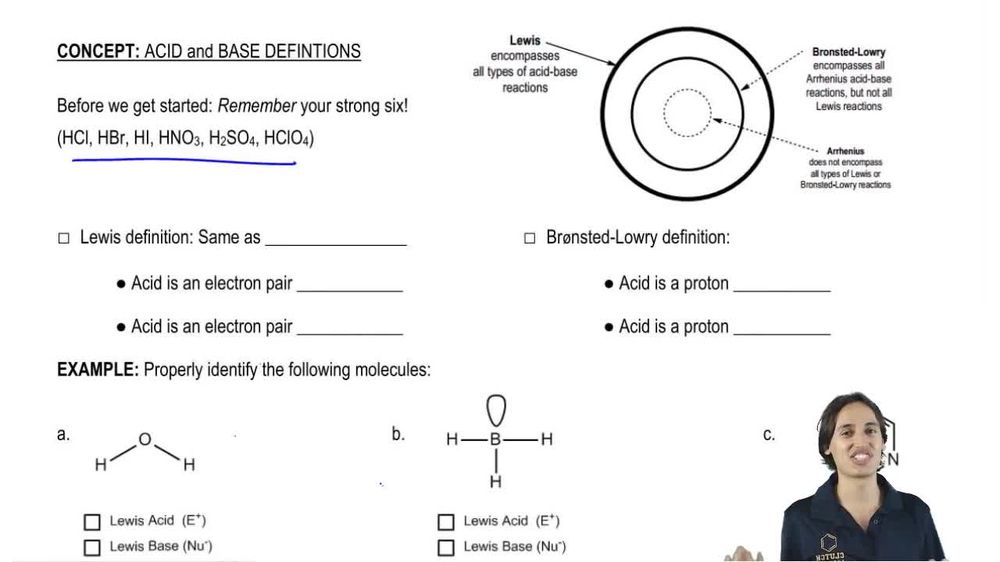
Step 2: Recall the definition of an acid. According to the Brønsted-Lowry theory, an acid is a species that donates a proton (H⁺). In this case, HBr is donating a proton to -C≡N, making HBr the acid on the left side of the equation.
Step 3: Recall the definition of a base. A base is a species that accepts a proton (H⁺). In this reaction, -C≡N is accepting a proton from HBr, making -C≡N the base on the left side of the equation.
Step 4: Confirm the products formed. When HBr donates a proton, it forms Br−, and when -C≡N accepts a proton, it forms HC≡N. This confirms the acid-base roles of HBr and -C≡N.
Step 5: Summarize the findings. The acid on the left side of the equation is HBr, and the base on the left side of the equation is -C≡N. These roles are determined by their ability to donate and accept protons, respectively.
Verified video answer for a similar problem:
This video solution was recommended by our tutors as helpful for the problem above
Video duration:
2m
Play a video:
0 Comments
Key Concepts
Here are the essential concepts you must grasp in order to answer the question correctly.
Acid-Base Theory
Acid-base theory explains the behavior of acids and bases in chemical reactions. According to the Brønsted-Lowry theory, an acid is a substance that donates a proton (H+), while a base is a substance that accepts a proton. This framework helps in identifying acids and bases in various chemical reactions, including those involving proton transfer.
Proton transfer is a fundamental process in acid-base reactions where a proton (H+) is transferred from the acid to the base. In the given reaction, HBr donates a proton to the cyanide ion (C≡N), illustrating how the transfer of protons defines the roles of acids and bases in the reaction. Understanding this concept is crucial for identifying the acid and base in the equation.
Equilibrium in chemical reactions refers to the state where the rates of the forward and reverse reactions are equal, resulting in constant concentrations of reactants and products. The double arrow in the reaction indicates that it can proceed in both directions, allowing for the identification of acids and bases based on their roles in the forward and reverse processes.

 2:10 minutes
 Verified step by step guidance
 02:49
02:49