Propose a mechanism for the following reactions: a.
Verified step by step guidance
1
Step 1: Analyze the starting material and reaction conditions. The starting material is a 2,5-dimethylfuran, a heterocyclic compound with an oxygen atom in the ring. The reaction conditions include HCl, water (H₂O), and heat (Δ), which suggest an acid-catalyzed hydrolysis mechanism.
Step 2: Protonation of the furan ring. Under acidic conditions, the oxygen atom in the furan ring is protonated by HCl, increasing the electrophilicity of the ring and making it more susceptible to nucleophilic attack.
Step 3: Nucleophilic attack by water. Water acts as a nucleophile and attacks the protonated furan ring, leading to the opening of the ring and the formation of an intermediate with hydroxyl groups attached to the carbons.
Step 4: Rearrangement and cleavage. The intermediate undergoes rearrangement and cleavage of bonds, leading to the formation of two carbonyl compounds. The heat (Δ) facilitates this process by providing the energy required for bond breaking and formation.
Step 5: Formation of final products. The reaction yields two ketones: acetone (CH₃COCH₃) and butan-2-one (CH₃CH₂COCH₃), as the final products. These are stabilized by resonance and the absence of further reactive groups under the given conditions.
Verified video answer for a similar problem:
This video solution was recommended by our tutors as helpful for the problem above
Video duration:
8m
Play a video:
0 Comments
Key Concepts
Here are the essential concepts you must grasp in order to answer the question correctly.
Reaction Mechanism
A reaction mechanism is a step-by-step description of how a chemical reaction occurs at the molecular level. It outlines the sequence of elementary steps, including bond breaking and formation, and the intermediates formed during the reaction. Understanding the mechanism is crucial for predicting the products and the conditions under which the reaction occurs.
Nucleophiles are species that donate an electron pair to form a chemical bond, while electrophiles are electron-deficient species that accept an electron pair. Identifying these species in a reaction is essential for proposing a mechanism, as it helps to determine the flow of electrons and the formation of new bonds. This concept is fundamental in organic reactions, particularly in substitution and addition reactions.
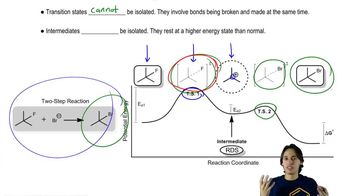
Transition states are high-energy states that occur during the transformation of reactants to products, representing the point of maximum energy along the reaction pathway. Intermediates are species that are formed during the reaction but are not present in the final products. Understanding these concepts is vital for visualizing the energy changes and the stability of different species throughout the reaction mechanism.