Identify the alcohol(s) that would produce the following alkenes under the given conditions. (a)
Verified step by step guidance
1
Step 1: Understand the reaction mechanism. The conversion of alcohols to alkenes typically occurs through an elimination reaction, such as E1 or E2, depending on the conditions. In acidic conditions, the reaction often proceeds via the E1 mechanism, involving protonation of the alcohol and formation of a carbocation intermediate.
Step 2: Analyze the structure of the given alkene. Identify the position of the double bond and the carbon atoms involved. This will help determine the possible alcohol precursors.
Step 3: Consider the regioselectivity and stereoselectivity of the elimination reaction. For example, Zaitsev's rule states that the most substituted alkene is usually favored in elimination reactions. This can help predict which alcohols are likely to produce the given alkene.
Step 4: Identify the alcohol(s) that could lead to the given alkene. For each alcohol, consider the position of the hydroxyl group (-OH) and how elimination would occur to form the double bond. Ensure that the elimination follows the correct mechanism (E1 or E2) under the given conditions.
Step 5: Verify the feasibility of the reaction. Check for factors such as carbocation stability (in E1 reactions) or the presence of a strong base (in E2 reactions) to confirm that the identified alcohol(s) can indeed produce the given alkene.
Verified video answer for a similar problem:
This video solution was recommended by our tutors as helpful for the problem above
Video duration:
3m
Play a video:
0 Comments
Key Concepts
Here are the essential concepts you must grasp in order to answer the question correctly.
Alcohol Dehydration
Alcohol dehydration is a chemical reaction where an alcohol loses a water molecule to form an alkene. This process typically occurs under acidic conditions, where the hydroxyl group of the alcohol is protonated, making it a better leaving group. The resulting carbocation can then undergo elimination of a proton, leading to the formation of a double bond in the alkene.
Zaitsev's Rule states that in elimination reactions, the more substituted alkene is generally the major product. This is because more substituted alkenes are more stable due to hyperconjugation and the inductive effect. Understanding this rule helps predict which alkene will be favored when multiple elimination products are possible from a given alcohol.
Regioselectivity refers to the preference of a chemical reaction to yield one structural isomer over others when multiple products are possible. In the context of alcohol dehydration, regioselectivity is influenced by the stability of the carbocation intermediate and the position of the double bond in the resulting alkene. Recognizing regioselectivity is crucial for determining the correct alcohol that will produce the desired alkene.

 3:23 minutes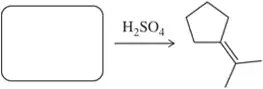
 Verified step by step guidance
 01:23
01:23