Predict the major products of dehydration catalyzed by sulfuric acid. (a) hexan-1-ol (b) hexan-2-ol (c) pentan-3-ol
Verified step by step guidance
1
Step 1: Understand the dehydration reaction. Dehydration of alcohols involves the removal of a water molecule, typically catalyzed by an acid like sulfuric acid. The reaction proceeds via the formation of a carbocation intermediate, and the major product is determined by the stability of the carbocation and the Zaitsev rule (favoring the more substituted alkene).
Step 2: Analyze hexan-1-ol (structure B). Hexan-1-ol is a primary alcohol. Upon dehydration, it forms a carbocation at the first carbon, which is unstable. Rearrangement does not occur, and the major product will be the least substituted alkene, 1-hexene.
Step 3: Analyze hexan-2-ol (structure C). Hexan-2-ol is a secondary alcohol. Upon dehydration, it forms a carbocation at the second carbon. This carbocation is relatively stable, and the major product will be the more substituted alkene, 2-hexene, following the Zaitsev rule.
Step 4: Analyze pentan-3-ol (structure A). Pentan-3-ol is a secondary alcohol. Upon dehydration, it forms a carbocation at the third carbon. This carbocation is stable, and the major product will be the more substituted alkene, 3-pentene, following the Zaitsev rule.
Step 5: Summarize the major products. For hexan-1-ol, the major product is 1-hexene. For hexan-2-ol, the major product is 2-hexene. For pentan-3-ol, the major product is 3-pentene. These products are formed based on carbocation stability and the Zaitsev rule.
Verified video answer for a similar problem:
This video solution was recommended by our tutors as helpful for the problem above
Video duration:
8m
Play a video:
0 Comments
Key Concepts
Here are the essential concepts you must grasp in order to answer the question correctly.
Dehydration Reaction
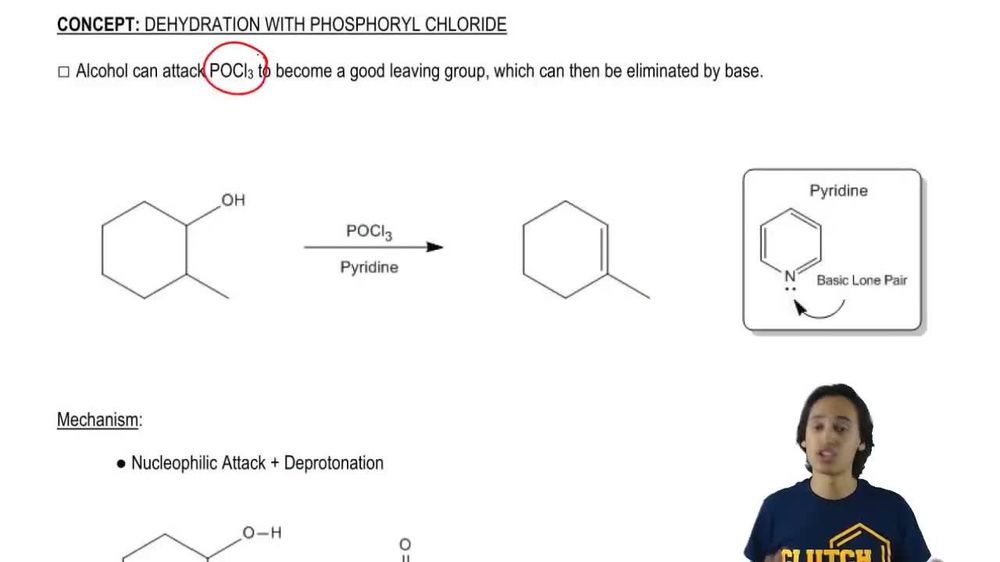
A dehydration reaction involves the removal of a water molecule from an alcohol to form an alkene. This process typically requires an acid catalyst, such as sulfuric acid, which protonates the alcohol, making it a better leaving group. The resulting carbocation can then undergo elimination to form a double bond, leading to the formation of alkenes as major products.
The stability of carbocations is crucial in determining the major products of dehydration reactions. Tertiary carbocations are more stable than secondary, which are more stable than primary. The formation of the most stable carbocation intermediate during the reaction pathway will favor the formation of the corresponding alkene, influencing the product distribution.
Markovnikov's Rule states that in the addition of HX to an alkene, the hydrogen atom will attach to the carbon with the greater number of hydrogen atoms already attached. This principle also applies to dehydration reactions, where the more substituted alkene is typically the major product due to the stability of the carbocation formed during the reaction.

 8:06 minutes
 Verified step by step guidance
 01:23
01:23