Ch. 12 - Radicals
Bruice - Organic Chemistry 8th Edition
Bruice8th EditionOrganic ChemistryISBN: 9780135213711Not the one you use?Change textbook
Chapter 13, Problem 40b

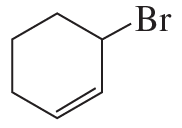
Starting with cyclohexane, how could the following compounds be prepared?
b. Cyclohexane structure with a bromine atom indicated, illustrating a radical reaction process.

Verified step by step guidance
1
Step 1: Begin with cyclohexane as the starting material. Cyclohexane is a saturated hydrocarbon with no double bonds or functional groups.
Step 2: Perform a bromination reaction to introduce a bromine atom onto the cyclohexane ring. This can be achieved using Br₂ in the presence of UV light, which facilitates a free radical substitution reaction. This step will yield bromocyclohexane.
Step 3: Dehydrohalogenation is required to introduce a double bond into the ring structure. Treat bromocyclohexane with a strong base, such as KOH or NaOH, in an alcoholic solution. The base will abstract a proton from a β-carbon, leading to the elimination of HBr and forming cyclohexene.
Step 4: Bromination of cyclohexene is necessary to add a bromine atom to the allylic position (the carbon adjacent to the double bond). Use NBS (N-bromosuccinimide) in the presence of light or heat to selectively brominate the allylic position, yielding the desired compound.
Step 5: Verify the structure of the final product, which should be 3-bromocyclohexene, ensuring the bromine atom is at the allylic position relative to the double bond.

Verified video answer for a similar problem:

This video solution was recommended by our tutors as helpful for the problem above.
Video duration:
4m
Was this helpful?

Key Concepts

Here are the essential concepts you must grasp in order to answer the question correctly.

Radical Reactions

Radical reactions involve the formation and reaction of free radicals, which are highly reactive species with unpaired electrons. In the context of bromocyclohexane synthesis, a radical halogenation reaction can be initiated by heat or light, leading to the substitution of a hydrogen atom in cyclohexane with a bromine atom, resulting in bromocyclohexane.
Recommended video:
Guided course
03:49
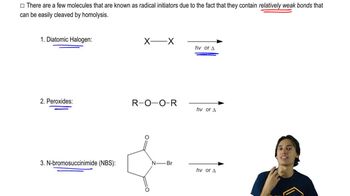
What are Radical Initiators?

Electrophilic Substitution

Electrophilic substitution is a key mechanism in organic chemistry where an electrophile replaces a hydrogen atom in an aromatic compound. Although cyclohexane is not aromatic, understanding this concept is crucial for recognizing how similar mechanisms can apply to cyclic compounds, especially when considering the reactivity of substituted cyclohexanes in further reactions.
Recommended video:
Guided course
01:47
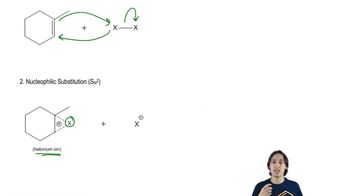
Nucleophiles and Electrophiles can react in Substitution Reactions.

Mechanism of Halogenation

The mechanism of halogenation typically involves the generation of a halogen radical, which then abstracts a hydrogen atom from the alkane, forming a new radical. This new radical can then react with another halogen molecule to form the halogenated product. Understanding this stepwise process is essential for predicting the outcome of reactions starting from cyclohexane to bromocyclohexane.
Recommended video:
Guided course
03:45
Halogenation Mechanism