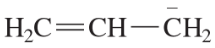
Draw the important resonance forms for the following molecules and ions. (a) CO32– (b) (c)
Verified step by step guidance
1
Identify the molecule or ion for which you need to draw resonance forms. In this case, we have carbonate ion (CO32-) and the allyl radical (H2C=CH—CH2).
For CO32-, recognize that it is a polyatomic ion with a charge of -2. The central carbon atom is bonded to three oxygen atoms. Start by drawing the Lewis structure with one double bond and two single bonds to the oxygen atoms.
Consider the movement of electrons to create resonance structures for CO32-. The double bond can shift between the oxygen atoms, creating equivalent resonance forms. Use arrows to indicate the movement of electrons from the double bond to form a new double bond with another oxygen atom, while the original double bond becomes a lone pair on the first oxygen.
For the allyl radical (H2C=CH—CH2), identify the pi bond between the first two carbon atoms and the unpaired electron on the third carbon. The resonance involves the movement of the pi electrons to form a new pi bond between the second and third carbon atoms, while the unpaired electron moves to the first carbon.
Draw the resonance structures for the allyl radical, showing the movement of electrons with curved arrows. Ensure that each resonance form maintains the correct number of electrons and follows the rules of resonance, such as conserving the total charge and maintaining the same number of unpaired electrons.
Verified video answer for a similar problem:
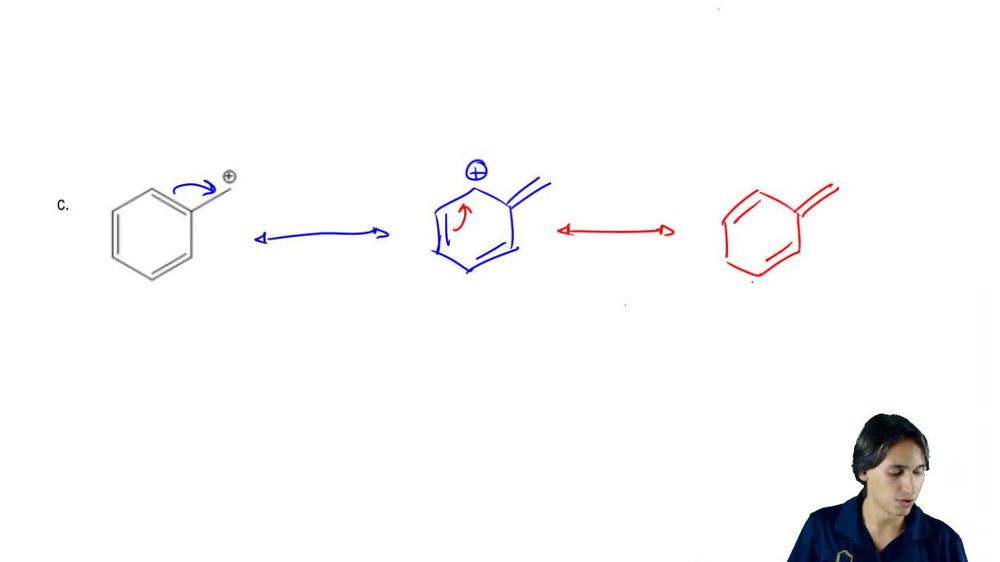
This video solution was recommended by our tutors as helpful for the problem above
Video duration:
8m
Play a video:
0 Comments
Key Concepts
Here are the essential concepts you must grasp in order to answer the question correctly.
Resonance Structures
Resonance structures are different Lewis structures for a molecule or ion that depict the same arrangement of atoms but differ in the distribution of electrons. They are used to represent delocalized electrons within certain molecules or polyatomic ions where the bonding cannot be expressed by a single Lewis structure. Understanding resonance is crucial for predicting the stability and reactivity of molecules.
Delocalization refers to the spreading of electron density across multiple atoms, which occurs in molecules with conjugated systems or resonance. This phenomenon stabilizes the molecule by allowing electrons to be shared over several atoms, reducing electron-electron repulsion and lowering the overall energy. Delocalization is a key factor in the stability of resonance structures.
Formal charge is a theoretical charge assigned to atoms in a molecule, calculated by assuming equal sharing of electrons in bonds. It is determined using the formula: Formal Charge = (Valence electrons) - (Non-bonding electrons) - (Bonding electrons/2). Calculating formal charges helps identify the most stable resonance structure, as structures with formal charges closest to zero are generally more stable.