For each of the following reactions, draw the major elimination product; if the product can exist as stereoisomers, indicate which stereoisomer is obtained in greater yield. e. 3-bromo-3-methylpentane + high concentration of CH3CH2O− f. 3-bromo-3-methylpentane + CH3CH2OH
Verified step by step guidance
1
Identify the type of elimination reaction (E1 or E2) for each scenario. For reaction (e), the presence of a strong base (CH3CH2O−) and high concentration suggests an E2 mechanism. For reaction (f), the use of a weaker base/nucleophile (CH3CH2OH) suggests an E1 mechanism.
For the E2 reaction (e), analyze the structure of 3-bromo-3-methylpentane. The β-hydrogens (hydrogens on carbons adjacent to the carbon bearing the leaving group) are located on the second and fourth carbons. Identify the β-hydrogens that are anti-periplanar to the leaving group (bromine).
In the E2 mechanism, the elimination occurs in a single concerted step. The base (CH3CH2O−) abstracts a β-hydrogen, the C-H bond breaks, and the C-Br bond breaks simultaneously, forming a double bond. Determine the major product by applying Zaitsev's rule, which states that the more substituted alkene is favored.
For the E1 reaction (f), the first step is the ionization of the C-Br bond to form a carbocation intermediate. Since 3-bromo-3-methylpentane forms a tertiary carbocation, it is highly stable. Next, a β-hydrogen is removed by the weak base (CH3CH2OH), leading to the formation of the alkene.
For both reactions, if the product can exist as stereoisomers (E/Z or cis/trans), determine the stereoisomer that is formed in greater yield. In E2 reactions, the anti-periplanar geometry often dictates the stereochemistry. In E1 reactions, the product distribution is governed by thermodynamic stability, favoring the more stable stereoisomer (usually the E isomer).
Verified video answer for a similar problem:
This video solution was recommended by our tutors as helpful for the problem above
Video duration:
4m
Play a video:
0 Comments
Key Concepts
Here are the essential concepts you must grasp in order to answer the question correctly.
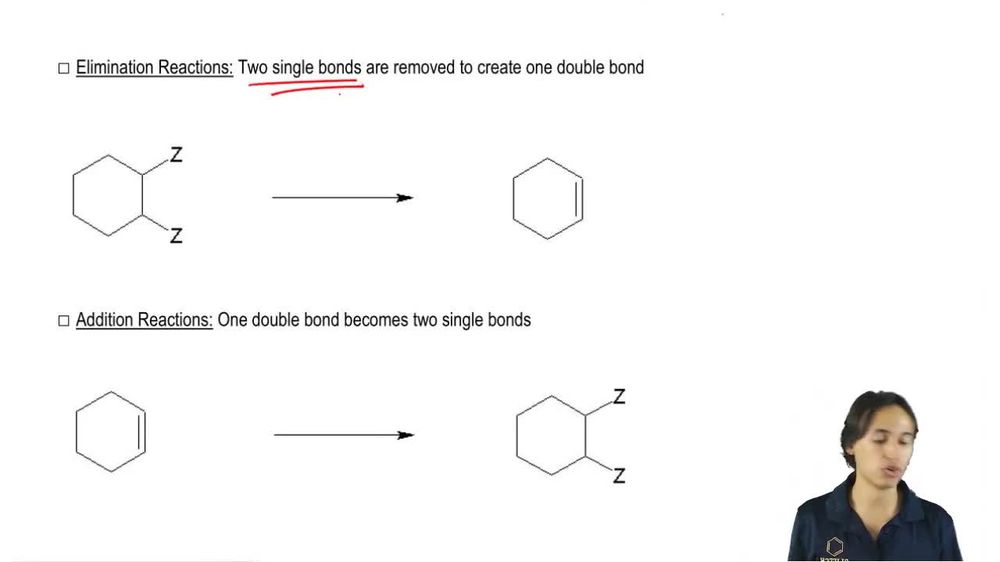
Elimination Reactions
Elimination reactions involve the removal of a small molecule from a larger one, typically resulting in the formation of a double bond. In organic chemistry, these reactions can follow either E1 or E2 mechanisms, depending on the conditions and the structure of the substrate. Understanding the mechanism is crucial for predicting the major product and its stereochemistry.
Stereochemistry refers to the study of the spatial arrangement of atoms in molecules and how this affects their chemical behavior. In elimination reactions, the stereochemistry of the product can lead to different stereoisomers, such as cis and trans forms. Recognizing which stereoisomer is favored in a reaction is essential for determining the major product.
Regioselectivity is the preference of a chemical reaction to yield one structural isomer over others when multiple products are possible. In the context of elimination reactions, this concept helps predict which alkene product will be formed based on the stability of the resulting double bond. Factors such as sterics and electronic effects play a significant role in determining the regioselectivity of the reaction.