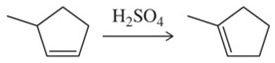
When using sulfuric acid, but in the absence of other nucleophiles like water or bromide ion, less stable alkenes can be isomerized to their more stable isomer. Provide a mechanism for these acid-catalyzed isomerization reactions. [This is one illustration of the principle of microscopic reversibility.] (b)
Verified step by step guidance
1
Step 1: Protonation of the less stable alkene occurs when sulfuric acid (H₂SO₄) donates a proton (H⁺) to the double bond. This forms a carbocation intermediate. The position of the carbocation depends on the stability of the intermediate formed.
Step 2: The carbocation undergoes rearrangement if necessary to form a more stable carbocation. This rearrangement can involve hydride shifts or alkyl group migrations to stabilize the positive charge.
Step 3: Deprotonation occurs at a different position, leading to the formation of a new double bond. This step regenerates the sulfuric acid catalyst and results in the isomerization of the alkene.
Step 4: The principle of microscopic reversibility ensures that the mechanism for the forward reaction (isomerization) is the reverse of the mechanism for the backward reaction. This means the same intermediates are involved in both directions.
Step 5: The final product is the more stable alkene, which is determined by factors such as hyperconjugation and the degree of substitution of the double bond. In this case, the double bond shifts to a position that results in a more substituted and stable alkene.
Verified video answer for a similar problem:
This video solution was recommended by our tutors as helpful for the problem above
Play a video:
0 Comments
Key Concepts
Here are the essential concepts you must grasp in order to answer the question correctly.
Acid-Catalyzed Isomerization
Acid-catalyzed isomerization involves the rearrangement of molecular structures under acidic conditions, typically facilitated by a protonation step. In this process, the acid donates a proton to the alkene, creating a more reactive carbocation intermediate. This intermediate can then undergo structural rearrangement to form a more stable isomer, often resulting in a shift from less stable to more stable alkene configurations.
Microscopic reversibility is a principle stating that the mechanism of a reaction can be reversed at the molecular level. This means that the steps leading to the formation of products can be retraced to regenerate the reactants. In the context of acid-catalyzed isomerization, this principle implies that the pathway taken to convert one isomer to another can also be followed in reverse, allowing for the interconversion of isomers under the right conditions.
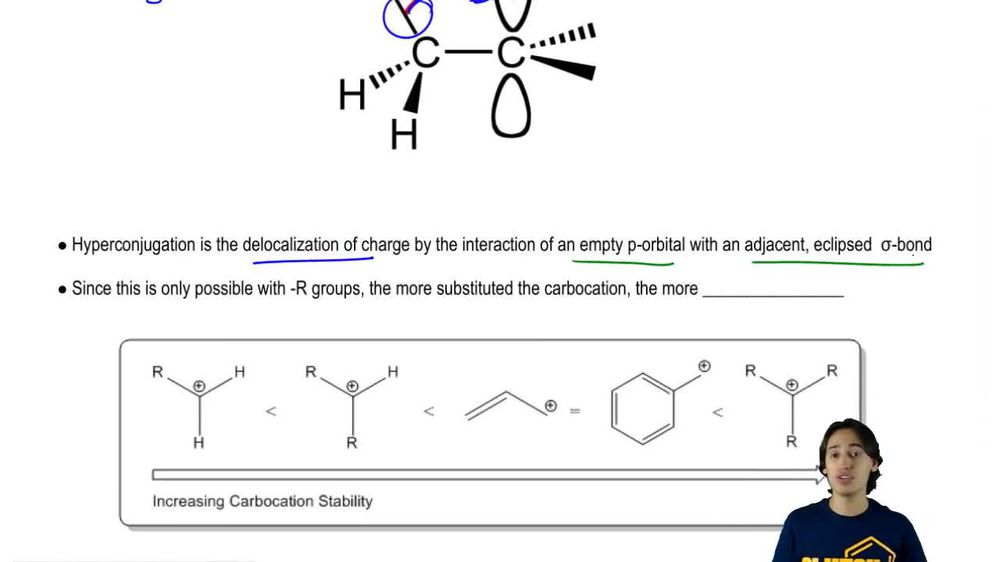
Carbocation stability is a key concept in organic chemistry that refers to the relative stability of positively charged carbon species. The stability of a carbocation is influenced by factors such as the degree of substitution (primary, secondary, tertiary) and resonance effects. More stable carbocations are favored during reactions, as they lower the energy barrier for the reaction pathway, making it easier for isomerization to occur.