The hydrogenation of alkenes is a reaction we study in Chapter 9. (b) Is this reaction favored or disfavored in terms of entropy?
Verified step by step guidance
1
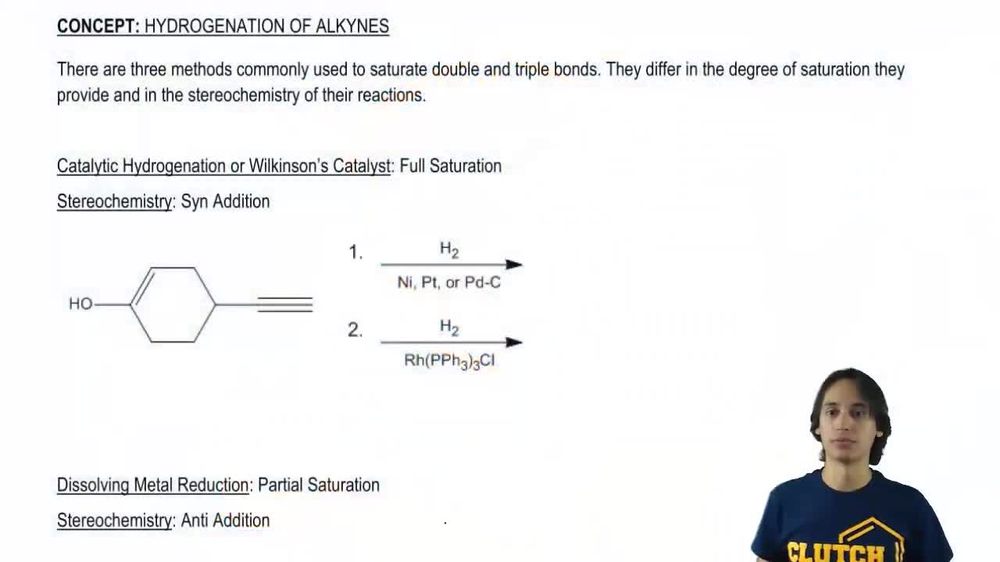
Understand the reaction: Hydrogenation of alkenes involves the addition of hydrogen (H₂) across a carbon-carbon double bond (C=C), converting the alkene into an alkane.
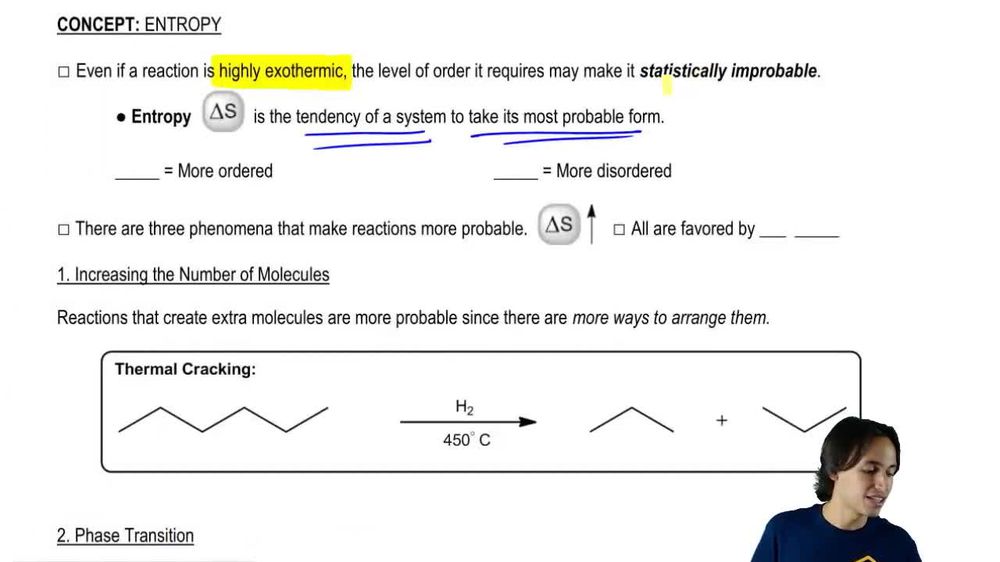
Recall the concept of entropy (ΔS): Entropy is a measure of disorder or randomness in a system. Reactions that increase the number of molecules or increase molecular freedom tend to have a positive ΔS, while reactions that decrease the number of molecules or restrict molecular freedom tend to have a negative ΔS.
Analyze the change in the number of molecules: In the hydrogenation reaction, one molecule of alkene reacts with one molecule of hydrogen gas (H₂) to form a single molecule of alkane. This results in a decrease in the total number of molecules in the system.
Relate the change in the number of molecules to entropy: Since the number of molecules decreases during the reaction, the system becomes more ordered, leading to a decrease in entropy (ΔS < 0).
Conclude whether the reaction is favored or disfavored in terms of entropy: A decrease in entropy (negative ΔS) means the reaction is entropically disfavored. However, note that the overall favorability of the reaction depends on both enthalpy (ΔH) and entropy (ΔS), as described by the Gibbs free energy equation (ΔG = ΔH - TΔS).
Verified video answer for a similar problem:
This video solution was recommended by our tutors as helpful for the problem above
Video duration:
4m
Play a video:
0 Comments
Key Concepts
Here are the essential concepts you must grasp in order to answer the question correctly.
Hydrogenation of Alkenes
Hydrogenation is a chemical reaction that involves the addition of hydrogen (H2) to an alkene, converting it into an alkane. This process typically occurs in the presence of a catalyst, such as palladium or platinum, and results in the saturation of the carbon-carbon double bond. Understanding this reaction is crucial for analyzing its thermodynamic properties, including entropy changes.
Entropy is a measure of the disorder or randomness in a system. In chemical reactions, changes in entropy can indicate whether a reaction is favored or disfavored. Generally, reactions that lead to an increase in the number of gas molecules or greater molecular freedom result in higher entropy, while those that produce more ordered structures, like the hydrogenation of alkenes, tend to decrease entropy.
The thermodynamics of reactions involves the study of energy changes and the favorability of chemical processes. In the context of hydrogenation, it is important to consider both enthalpy and entropy to determine the overall Gibbs free energy change. A reaction is favored if the Gibbs free energy change is negative, which can occur when the enthalpic benefits outweigh the entropic costs, as seen in the hydrogenation of alkenes.

 4:56 minutes
 Verified step by step guidance
 00:48
00:48