For each reaction, estimate whether ΔS° for the reaction is positive, negative, or impossible to predict. (c)
Verified step by step guidance
1
Analyze the reaction: The reaction involves the conversion of acetic acid (CH3COOH) and methanol (CH3OH) into methyl acetate (CH3COOCH3) and water (H2O). This is an esterification reaction.
Consider the number of molecules on each side: On the reactant side, there are two molecules (CH3COOH and CH3OH). On the product side, there are also two molecules (CH3COOCH3 and H2O). Since the number of molecules remains the same, there is no significant change in the positional entropy due to the number of particles.
Evaluate the structural changes: The reactants are a carboxylic acid and an alcohol, while the products are an ester and water. The formation of an ester involves the creation of a more ordered structure, which may slightly decrease entropy.
Consider the phase of the reactants and products: If all species are in the same phase (e.g., liquid), the entropy change due to phase differences is negligible. However, if there are phase changes, this could influence ΔS°.
Conclude the trend: Based on the structural ordering and the lack of change in the number of molecules, ΔS° for this reaction is likely to be slightly negative due to the formation of a more ordered ester structure.
Verified video answer for a similar problem:
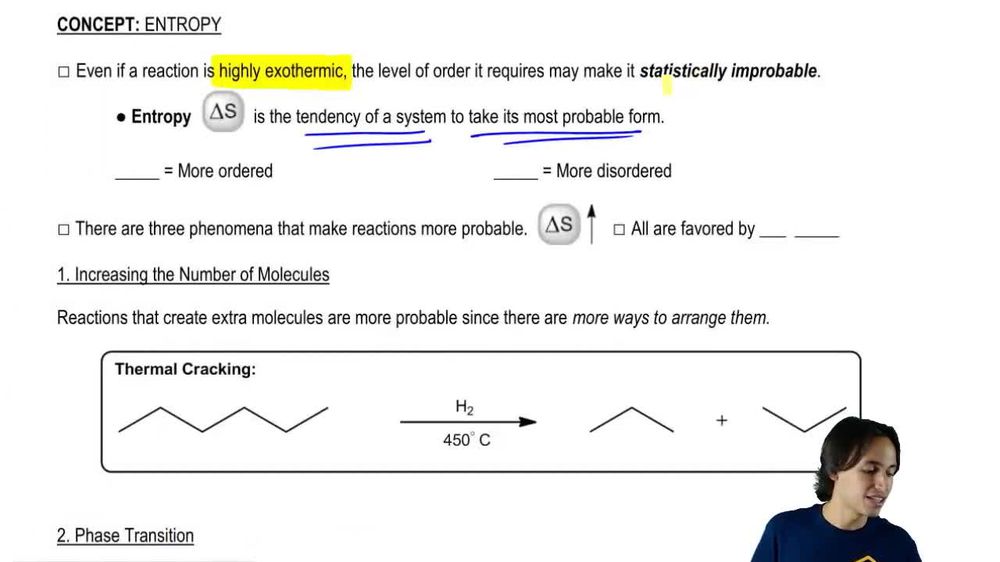
This video solution was recommended by our tutors as helpful for the problem above
Video duration:
3m
Play a video:
0 Comments
Key Concepts
Here are the essential concepts you must grasp in order to answer the question correctly.
Entropy (ΔS°)
Entropy, denoted as ΔS°, is a measure of the disorder or randomness in a system. In chemical reactions, a positive ΔS° indicates an increase in disorder, while a negative ΔS° suggests a decrease in disorder. Understanding how the number of moles of gaseous and liquid products and reactants changes during a reaction is crucial for predicting the sign of ΔS°.
Reaction stoichiometry involves the quantitative relationships between reactants and products in a chemical reaction. In the given reaction, analyzing the number of molecules and their states (liquid, gas) helps determine how the overall disorder changes. For example, if more molecules are produced than consumed, the reaction likely has a positive ΔS°.
Le Chatelier's Principle states that if a system at equilibrium is disturbed, it will shift in a direction that counteracts the disturbance. In the context of the given reaction, understanding how the equilibrium position affects the concentrations of reactants and products can provide insights into the entropy changes. This principle is essential for predicting how changes in conditions might influence ΔS°.