Beginning with benzene, synthesize the following substituted benzenes. The ideal number of steps is indicated. (d)
Verified step by step guidance
1
Step 1: Begin with benzene and perform a sulfonation reaction. This involves treating benzene with concentrated sulfuric acid (H2SO4) to introduce a sulfonic acid group (SO3H) onto the benzene ring, forming benzenesulfonic acid.
Step 2: Next, perform a Friedel-Crafts acylation to introduce the acyl group. Use an acyl chloride (such as acetyl chloride, CH3COCl) in the presence of a Lewis acid catalyst like aluminum chloride (AlCl3) to add the acyl group to the benzene ring. This will result in the formation of an acylated benzene derivative.
Step 3: Finally, carry out a bromination reaction. Treat the acylated benzene with bromine (Br2) in the presence of a catalyst such as iron(III) bromide (FeBr3) to introduce a bromine atom onto the benzene ring. The bromine will preferentially add to the position ortho to the acyl group due to the directing effects of the substituents already present on the ring.
Verified video answer for a similar problem:
This video solution was recommended by our tutors as helpful for the problem above
Video duration:
7m
Play a video:
0 Comments
Key Concepts
Here are the essential concepts you must grasp in order to answer the question correctly.
Electrophilic Aromatic Substitution (EAS)
Electrophilic Aromatic Substitution is a fundamental reaction mechanism in organic chemistry where an electrophile replaces a hydrogen atom on an aromatic ring. This process is crucial for introducing substituents like bromine, sulfonic acid, and carboxylic acid groups onto benzene. Understanding the directing effects of existing substituents is essential for predicting the position of new groups.
Substituents on a benzene ring influence the position of incoming groups during EAS reactions. Activating groups, like -OH or -NH2, direct new substituents to ortho/para positions, while deactivating groups, like -NO2 or -SO3H, direct to the meta position. Recognizing these effects is vital for planning multi-step syntheses, as seen in the synthesis of the given substituted benzene.
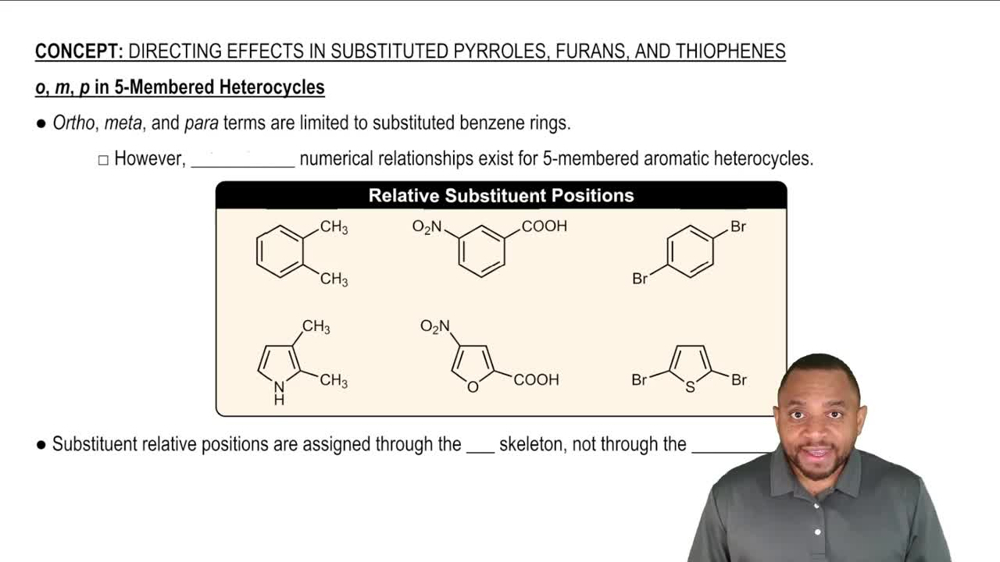
Directing Effects in Substituted Pyrroles, Furans, and Thiophenes Concept 1
Functional Group Interconversion
Functional Group Interconversion involves transforming one functional group into another, a key strategy in organic synthesis. For instance, converting a nitro group to an amine or an alkyl group to a carboxylic acid can be necessary steps in a synthetic route. In the context of the given problem, understanding how to introduce and modify functional groups efficiently is crucial for achieving the target molecule in the specified number of steps.

 7:01 minutes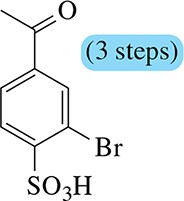
 Verified step by step guidance
 03:07
03:07