Benzene underwent a Friedel–Crafts acylation followed by a Wolff–Kishner reduction. The product gave the following 1H NMR spectrum. What acyl chloride was used in the Friedel–Crafts acylation? <IMAGE>
Verified step by step guidance
1
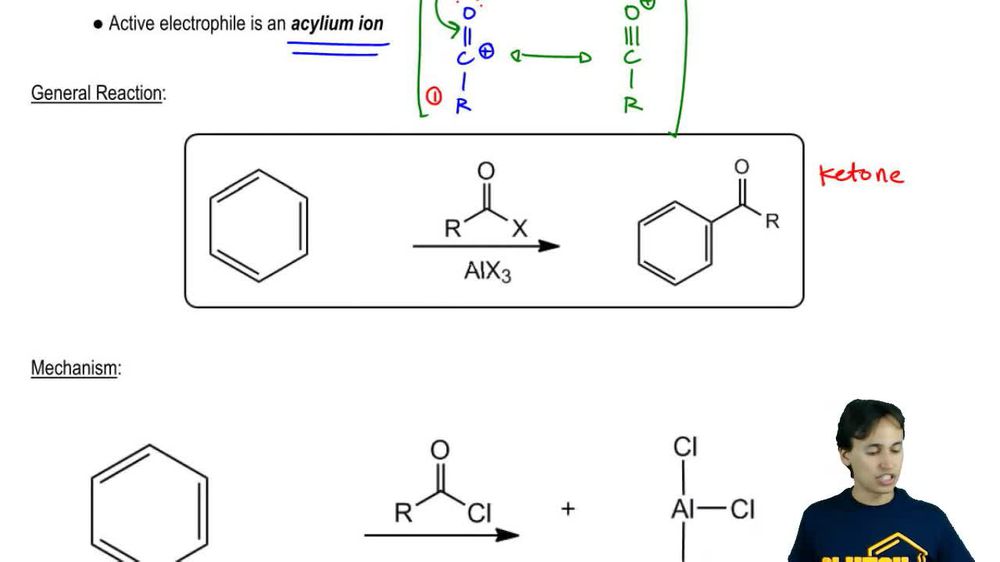
Analyze the Friedel–Crafts acylation reaction: In this reaction, benzene reacts with an acyl chloride (RCOCl) in the presence of a Lewis acid catalyst (e.g., AlCl₃) to form an aromatic ketone. The acyl group (RCO-) is introduced onto the benzene ring.
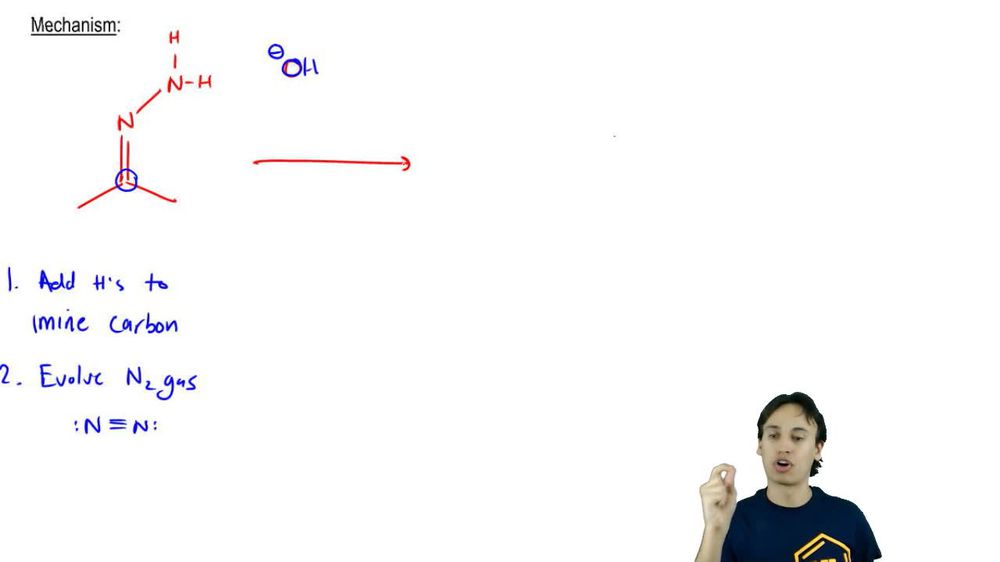
Understand the Wolff–Kishner reduction: This reaction reduces a ketone (C=O) to a methylene group (-CH₂-) using hydrazine (N₂H₄) and a strong base (e.g., KOH) under heat. The ketone formed in the Friedel–Crafts acylation will be reduced to an alkyl group.
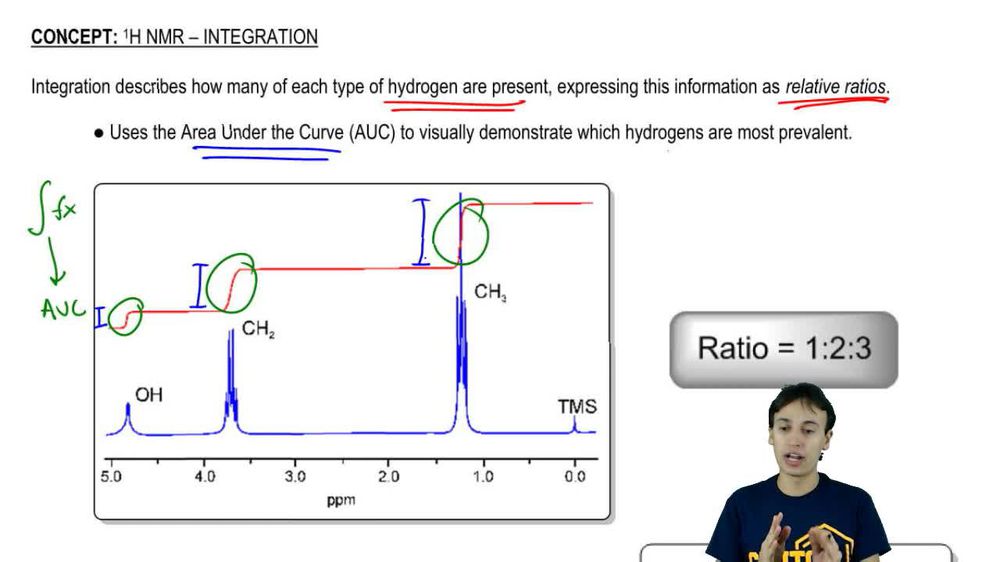
Interpret the 1H NMR spectrum: Examine the chemical shifts, splitting patterns, and integration values in the spectrum. These features will help identify the structure of the final product and, by extension, the acyl group introduced in the Friedel–Crafts acylation.
Work backward from the final product: Based on the NMR data, determine the structure of the alkyl group attached to the benzene ring after the Wolff–Kishner reduction. This alkyl group corresponds to the R group in the original acyl chloride (RCOCl).
Identify the acyl chloride: Use the structure of the alkyl group deduced from the NMR spectrum to determine the corresponding acyl chloride (RCOCl) that was used in the Friedel–Crafts acylation.
Verified video answer for a similar problem:
This video solution was recommended by our tutors as helpful for the problem above
Video duration:
4m
Play a video:
0 Comments
Key Concepts
Here are the essential concepts you must grasp in order to answer the question correctly.
Friedel–Crafts Acylation
Friedel–Crafts acylation is an electrophilic aromatic substitution reaction where an acyl group is introduced into an aromatic ring using an acyl chloride and a Lewis acid catalyst. This reaction allows for the formation of ketones on the aromatic compound, which can significantly alter its reactivity and properties. Understanding the mechanism and the role of the catalyst is crucial for predicting the product structure.
The Wolff–Kishner reduction is a chemical reaction that reduces carbonyl compounds, such as ketones and aldehydes, to alkanes using hydrazine and a strong base, typically potassium hydroxide. This reaction is important in organic synthesis for removing functional groups while preserving the carbon skeleton. Recognizing how this reduction affects the structure of the product is essential for interpreting the final outcome of the reaction sequence.
Proton nuclear magnetic resonance (1H NMR) spectroscopy is a powerful analytical technique used to determine the structure of organic compounds by analyzing the magnetic environment of hydrogen atoms in a molecule. The chemical shifts, splitting patterns, and integration of peaks provide insights into the molecular structure, including the presence of functional groups and the connectivity of atoms. Interpreting the 1H NMR spectrum is key to identifying the acyl chloride used in the acylation step.

 4:41 minutes
 Verified step by step guidance
 05:20
05:20