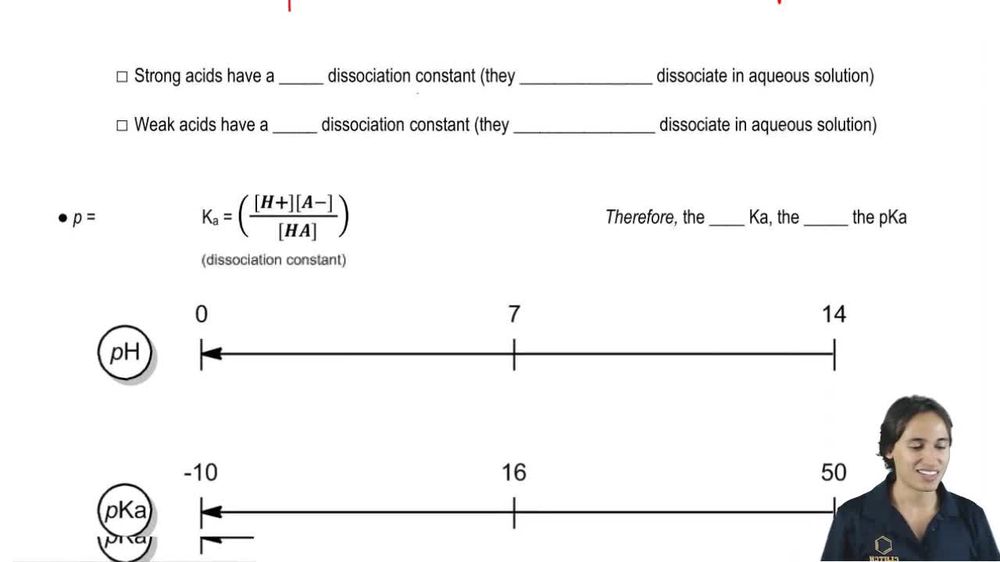
We usually calculate Keq for acid–base reactions using pKa values. (a) Derive an equation to calculate Keq using pKb values, then (b) use it to calculate the equilibrium constant for the following reaction.
Verified step by step guidance
1
Step 1: Recall the relationship between pKa and pKb. The relationship is given by the equation: (at 25°C). This equation connects the acid dissociation constant (Ka) and the base dissociation constant (Kb).
Step 2: Express the equilibrium constant (Keq) for an acid-base reaction in terms of Ka and Kb. For an acid-base reaction, . This equation shows that Keq is the ratio of the acid's Ka to the base's Kb.
Step 3: Convert the Ka and Kb values into their logarithmic forms using the pKa and pKb values. Recall that and . Substitute these into the Keq equation.
Step 4: Simplify the equation for Keq in terms of pKa and pKb. Using the properties of exponents, the equation becomes: . This is the derived equation to calculate Keq using pKb values.
Step 5: Apply the derived equation to the given reaction. Identify the pKa of the acid and the pKb of the base involved in the reaction. Substitute these values into the equation to calculate the equilibrium constant.
Verified video answer for a similar problem:
This video solution was recommended by our tutors as helpful for the problem above
Video duration:
5m
Play a video:
0 Comments
Key Concepts
Here are the essential concepts you must grasp in order to answer the question correctly.
pKₐ and pKₑq Relationship
The pKₐ value is a measure of the strength of an acid in solution, defined as the negative logarithm of the acid dissociation constant (Kₐ). Similarly, pKₑq is the negative logarithm of the equilibrium constant (Kₑq) for a reaction. The relationship between pKₐ and pKₑq allows us to derive equations that connect these values, facilitating the calculation of equilibrium constants for acid-base reactions.
For acid-base reactions, the equilibrium constant can be calculated using the pKₐ of the acid and the pKₑb of the base involved. The equation Kₑq = 10^(pKₐ + pKₑb) allows us to derive Kₑq from the respective pK values. This relationship is crucial for understanding how the strengths of acids and bases influence the position of equilibrium in a reaction.
Draw all of the monochlorination products and calculate percentage yields.
Equilibrium Constant (Kₑq)
The equilibrium constant (Kₑq) quantifies the ratio of the concentrations of products to reactants at equilibrium for a given reaction. It provides insight into the extent to which a reaction proceeds and is influenced by temperature and the nature of the reactants and products. Understanding Kₑq is essential for predicting the behavior of acid-base reactions and their equilibria.

 5:33 minutes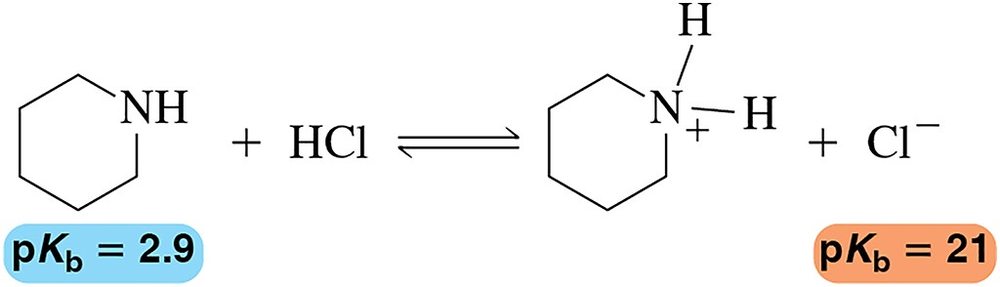
 Verified step by step guidance
 02:56
02:56