Step 1: Identify the acid and base on both sides of the reaction. In this case, the alcohol (CH3CH2OH) acts as the acid, and hydroxide ion (OH⁻) acts as the base. On the product side, the ethoxide ion (CH3CH2O⁻) is the conjugate base, and water (H2O) is the conjugate acid.
Step 2: Determine the pKa values of the acid and conjugate acid. The pKa of ethanol (CH3CH2OH) is approximately 16, and the pKa of water (H2O) is approximately 15.7.
Step 3: Use the relationship between pKa values and equilibrium constant (Keq). The formula is: Keq = 10^(pKa(conjugate acid) - pKa(acid)).
Step 4: Substitute the pKa values into the formula. Here, pKa(conjugate acid) = 15.7 (for H2O) and pKa(acid) = 16 (for CH3CH2OH).
Step 5: Calculate the exponent (pKa difference) and express the equilibrium constant (Keq) in terms of 10 raised to the power of the difference. This will give the final Keq value for the reaction.
Verified video answer for a similar problem:
This video solution was recommended by our tutors as helpful for the problem above
Play a video:
0 Comments
Key Concepts
Here are the essential concepts you must grasp in order to answer the question correctly.
Equilibrium Constant (K_eq)
The equilibrium constant, K_eq, quantifies the ratio of the concentrations of products to reactants at equilibrium for a given reaction. It is calculated using the formula K_eq = [products]/[reactants], where the concentrations are raised to the power of their coefficients in the balanced equation. A K_eq greater than 1 indicates that products are favored, while a value less than 1 suggests that reactants are favored.
The relationship between equilibrium constant and pKa.
Acid-Base Reactions
Acid-base reactions involve the transfer of protons (H+) between reactants. In these reactions, acids donate protons, while bases accept them. Understanding the strength of acids and bases, often represented by their dissociation constants (K_a for acids and K_b for bases), is crucial for predicting the direction of the reaction and calculating K_eq.
Le Chatelier's Principle states that if a system at equilibrium is disturbed, the system will adjust to counteract the disturbance and restore a new equilibrium. This principle is essential in predicting how changes in concentration, pressure, or temperature will affect the position of equilibrium in acid-base reactions, thereby influencing the calculation of K_eq.


 Verified step by step guidance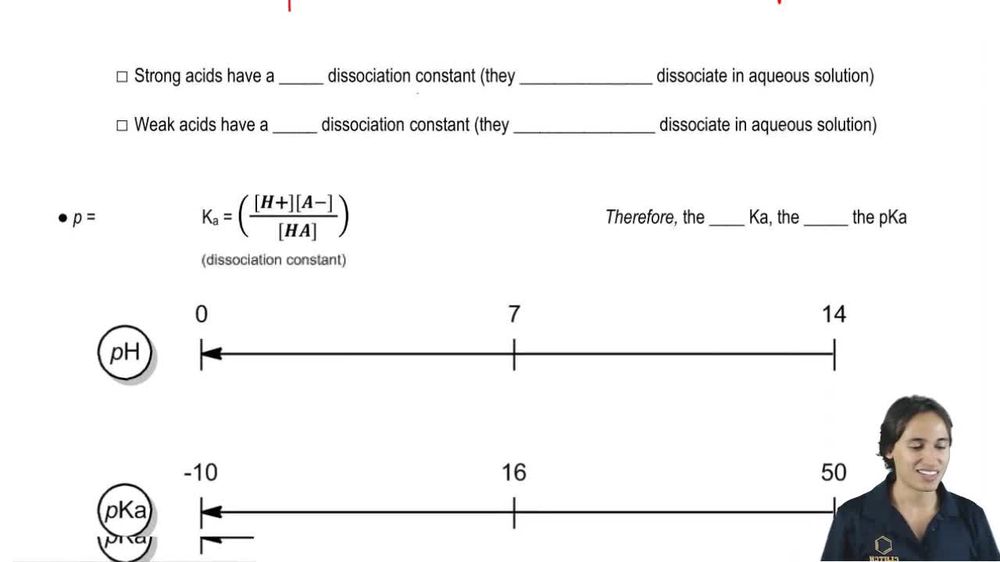
 02:19
02:19