Predict the products of the following reactions: (d)
Verified step by step guidance
1
Step 1: Analyze the given reactants and reagents. The starting compound is butan-2-one, a ketone. The first set of reagents, KCN and HCN, indicates a cyanohydrin formation reaction. The second reagent, LiAlH4, is a strong reducing agent used to reduce functional groups such as nitriles to primary amines.
Step 2: Understand the mechanism of cyanohydrin formation. In the presence of KCN and HCN, the ketone undergoes nucleophilic addition. The cyanide ion (CN⁻) attacks the carbonyl carbon of butan-2-one, forming a tetrahedral intermediate. Protonation by HCN leads to the formation of a cyanohydrin, which contains both a hydroxyl (-OH) group and a nitrile (-CN) group.
Step 3: Predict the structure of the cyanohydrin product. The carbonyl group of butan-2-one is converted into a hydroxyl group, and a nitrile group is added to the same carbon. The resulting compound is 2-hydroxy-2-methylbutanenitrile.
Step 4: Understand the reduction step with LiAlH4. LiAlH4 reduces the nitrile group (-CN) in the cyanohydrin to a primary amine (-CH₂NH₂). The hydroxyl group (-OH) remains unchanged during this reduction.
Step 5: Predict the final product. After the reduction step, the final product is 2-hydroxy-2-methylbutanamine, which contains both a hydroxyl group and a primary amine group on the same carbon.
Verified video answer for a similar problem:
This video solution was recommended by our tutors as helpful for the problem above
Video duration:
1m
Play a video:
0 Comments
Key Concepts
Here are the essential concepts you must grasp in order to answer the question correctly.
Nucleophilic Addition
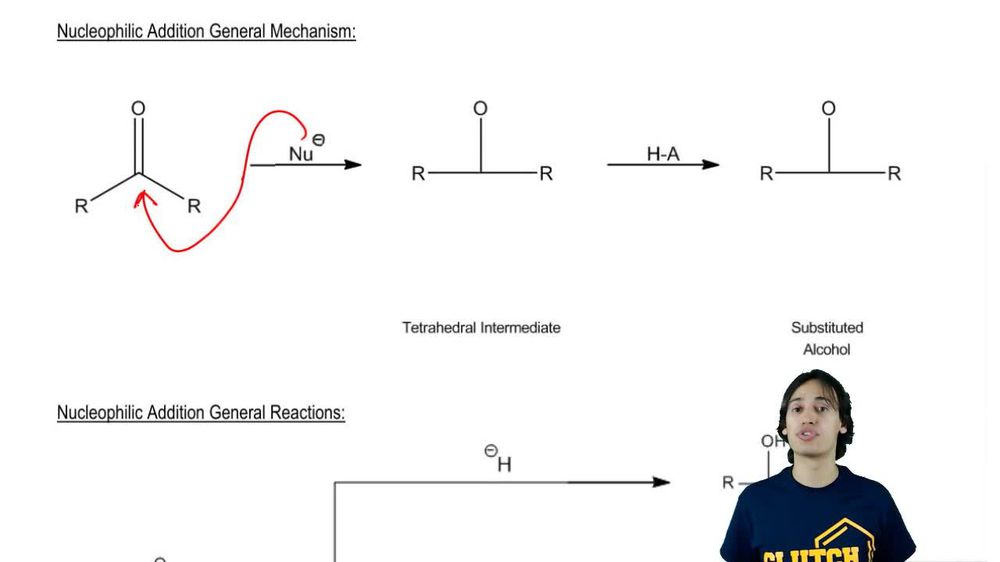
Nucleophilic addition is a fundamental reaction mechanism in organic chemistry where a nucleophile attacks an electrophilic carbon atom, typically in a carbonyl group. In this case, KCN and HCN act as nucleophiles that add to the carbonyl carbon of butan-2-one, leading to the formation of a cyanohydrin intermediate.
Reduction reactions involve the gain of electrons or the decrease in oxidation state of a molecule. In the second step of the reaction, LiAlH4 is a strong reducing agent that reduces the cyanohydrin formed in the first step to an alcohol, specifically converting the nitrile group into a primary amine or alcohol, depending on the reaction conditions.
Functional group transformation refers to the conversion of one functional group into another through chemical reactions. In this reaction sequence, butan-2-one undergoes transformation first into a cyanohydrin and then into an alcohol, showcasing how different reagents can modify the functional groups present in organic molecules.

 1:52 minutes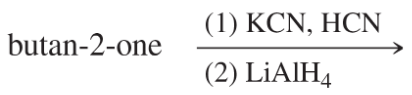
 Verified step by step guidance
 08:27
08:27