How could you convert N-methylbenzamide to the following compounds? a. N-methylbenzylamine
Verified step by step guidance
1
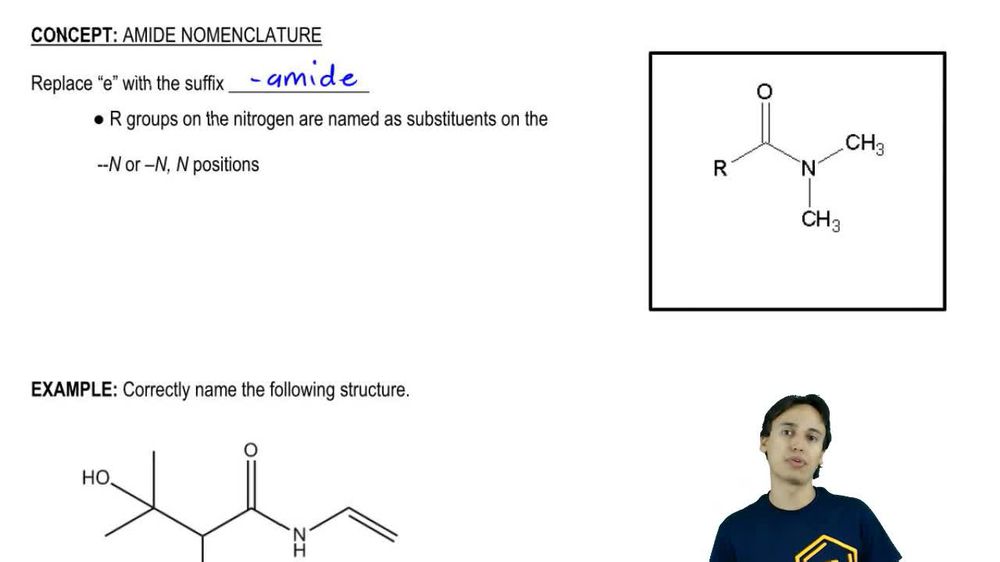
Step 1: Identify the functional groups in N-methylbenzamide. The molecule contains an amide group (-CONH-) attached to a benzene ring and a methyl group attached to the nitrogen atom.
Step 2: Recognize that the target compound, N-methylbenzylamine, contains a primary amine (-NH2) group attached to a benzyl group and a methyl group attached to the nitrogen atom. This indicates that the amide group must be reduced to an amine.
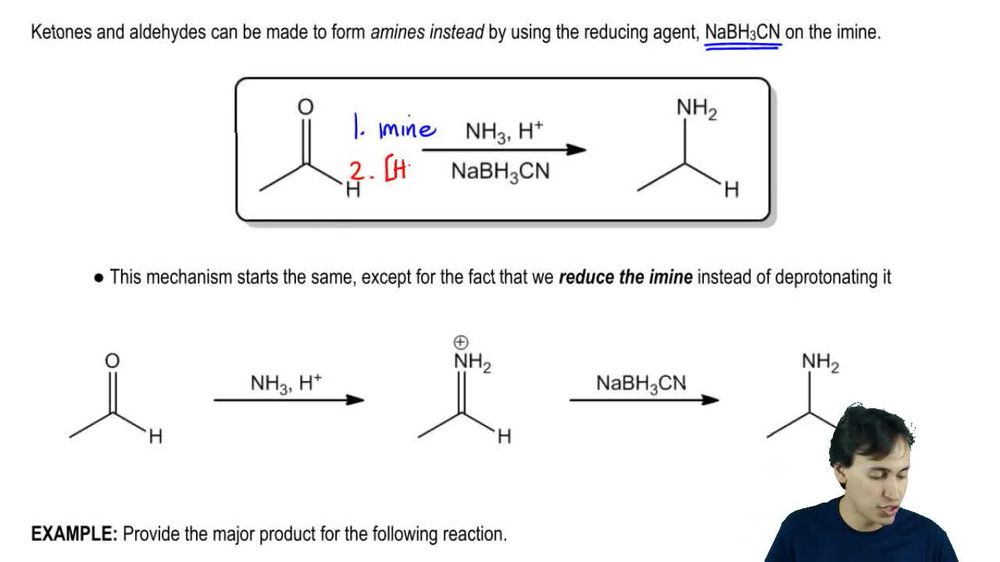
Step 3: Select an appropriate reducing agent for the conversion of the amide to an amine. Lithium aluminum hydride (LiAlH4) is a common and effective reducing agent for this transformation.
Step 4: Outline the reaction conditions. The reduction of N-methylbenzamide to N-methylbenzylamine using LiAlH4 typically requires anhydrous conditions and is followed by hydrolysis to neutralize the reaction mixture.
Step 5: Write the reaction mechanism. The LiAlH4 donates hydride ions (H-) to the carbonyl carbon of the amide, breaking the C=O bond and forming an intermediate. Subsequent steps lead to the formation of the amine product, N-methylbenzylamine.
Verified video answer for a similar problem:
This video solution was recommended by our tutors as helpful for the problem above
Video duration:
1m
Play a video:
0 Comments
Key Concepts
Here are the essential concepts you must grasp in order to answer the question correctly.
Amide Hydrolysis
Amide hydrolysis is a chemical reaction where an amide reacts with water to form a carboxylic acid and an amine. In the context of converting N-methylbenzamide to N-methylbenzylamine, hydrolysis can be facilitated by acidic or basic conditions, breaking the carbon-nitrogen bond and allowing for further transformations.
Reduction reactions involve the gain of electrons or the decrease in oxidation state of a molecule. In organic chemistry, reducing agents can convert carbonyl groups (like those in amides) to amines. In this case, the reduction of the carbonyl carbon in N-methylbenzamide leads to the formation of N-methylbenzylamine.
Nucleophilic substitution is a fundamental reaction mechanism in organic chemistry where a nucleophile replaces a leaving group in a molecule. In the conversion of N-methylbenzamide to N-methylbenzylamine, the amine group acts as a nucleophile, attacking the carbon atom of the carbonyl group, facilitating the substitution and formation of the desired product.

 1:10 minutes
 Verified step by step guidance
 01:33
01:33