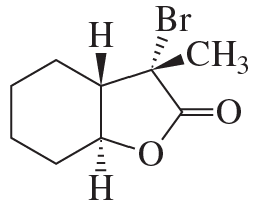
Draw the major elimination product that would be obtained from each of the following reactants with a strong base and with a weak base: a.
Verified step by step guidance
1
Analyze the structure: The given compound is a brominated cyclopentanone with substituents at the 2-position (Br and CH3) and 3-position (H and CH3). The bromine atom is a good leaving group, making this molecule suitable for elimination reactions.
Determine the elimination mechanism: With a strong base, the reaction typically follows the E2 mechanism, which is a one-step process requiring anti-periplanar geometry between the leaving group (Br) and the β-hydrogen. With a weak base, the reaction may proceed via the E1 mechanism, which involves a carbocation intermediate.
Identify β-hydrogens: The β-hydrogens are located on the carbon atoms adjacent to the carbon bonded to the bromine atom. In this case, the β-hydrogens are on the 3-position (attached to the carbon with the H and CH3 substituents).
Predict the major product with a strong base: For the E2 mechanism, the anti-periplanar geometry must be considered. The β-hydrogen on the same plane as the bromine will be abstracted, leading to the formation of a double bond between the 2-position and 3-position carbons. The major product will be the most stable alkene, likely the one with the methyl group contributing to hyperconjugation.
Predict the major product with a weak base: For the E1 mechanism, the bromine leaves first, forming a carbocation at the 2-position. The carbocation is stabilized by resonance with the ketone group. The β-hydrogen is then removed, forming the most substituted and stable alkene as the major product.
Verified video answer for a similar problem:
This video solution was recommended by our tutors as helpful for the problem above
Video duration:
5m
Play a video:
0 Comments
Key Concepts
Here are the essential concepts you must grasp in order to answer the question correctly.
Elimination Reactions
Elimination reactions involve the removal of atoms or groups from a molecule, resulting in the formation of a double bond or a ring structure. In organic chemistry, these reactions can be classified as E1 or E2, depending on the mechanism. E2 reactions typically require a strong base and occur in a single concerted step, while E1 reactions involve a two-step mechanism with a carbocation intermediate, often favored by weak bases.
The strength of a base significantly influences the outcome of elimination reactions. Strong bases, such as sodium hydride (NaH) or potassium tert-butoxide (KOtBu), promote E2 mechanisms, leading to the formation of alkenes. In contrast, weak bases, like water or alcohols, may favor E1 mechanisms, resulting in different products due to the stability of intermediates and the reaction conditions.
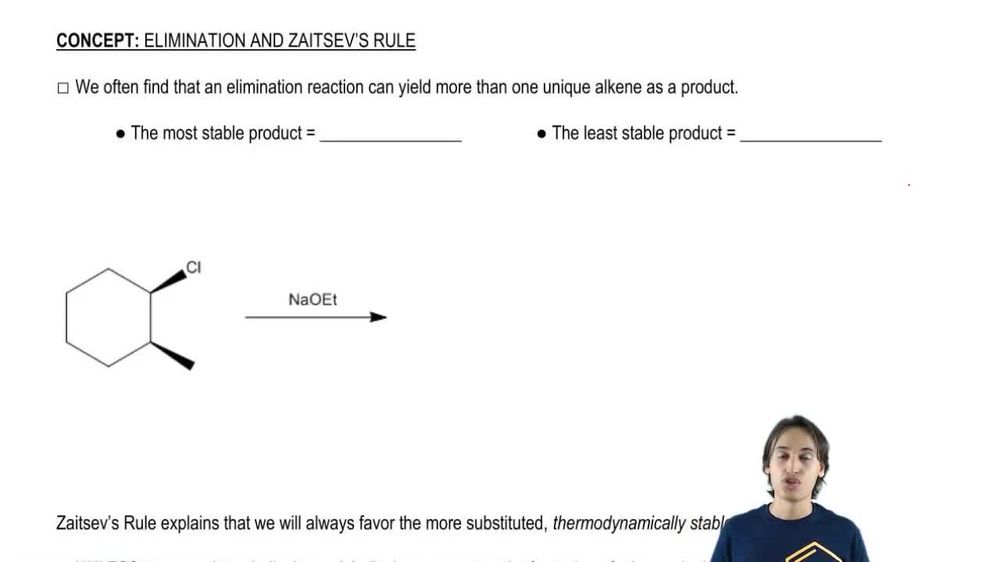
Zaitsev's Rule states that in elimination reactions, the more substituted alkene is typically the major product. This is due to the stability of more substituted double bonds, which are less reactive and more thermodynamically favorable. Understanding this rule helps predict the major product when analyzing elimination reactions, especially when considering the base strength and the structure of the reactants.