a. Draw the structures of the products obtained from the reaction of each enantiomer of cis-1-chloro-2-isopropylcyclopentane with sodium methoxide in methanol. b. Are all the products optically active?
Verified step by step guidance
1
Step 1: Understand the reaction mechanism. Sodium methoxide (CH₃ONa) in methanol is a strong base and a nucleophile. The reaction will proceed via an E2 elimination mechanism because the substrate is a secondary alkyl halide (cis-1-chloro-2-isopropylcyclopentane). In an E2 mechanism, the base abstracts a β-hydrogen, and the leaving group (Cl⁻) departs simultaneously, forming a double bond.
Step 2: Identify the β-hydrogens. In cis-1-chloro-2-isopropylcyclopentane, the β-hydrogens are located on the carbons adjacent to the carbon bearing the chlorine atom. Since the molecule is cis-configured, the β-hydrogens must be anti-periplanar (in opposite planes) to the leaving group for the E2 elimination to occur.
Step 3: Draw the products for each enantiomer. For each enantiomer of cis-1-chloro-2-isopropylcyclopentane, identify the anti-periplanar β-hydrogens and eliminate HCl to form the corresponding alkenes. The products will be alkenes with different stereochemistry depending on the starting enantiomer.
Step 4: Analyze the optical activity of the products. Determine whether the alkenes formed are chiral (optically active) or achiral (optically inactive). Recall that a molecule is optically active if it lacks a plane of symmetry and has a chiral center or axis.
Step 5: Summarize the results. Conclude whether all the products are optically active or if some are optically inactive. Consider the stereochemistry of the alkenes formed and whether they exhibit chirality or symmetry.
Verified video answer for a similar problem:
This video solution was recommended by our tutors as helpful for the problem above
Video duration:
2m
Play a video:
0 Comments
Key Concepts
Here are the essential concepts you must grasp in order to answer the question correctly.
Enantiomers
Enantiomers are pairs of molecules that are non-superimposable mirror images of each other. They have identical physical properties except for their interaction with polarized light and reactions in chiral environments. Understanding enantiomers is crucial for predicting the outcomes of reactions involving chiral centers, such as the one described in the question.
How to solve for the percentage of each enantiomer.
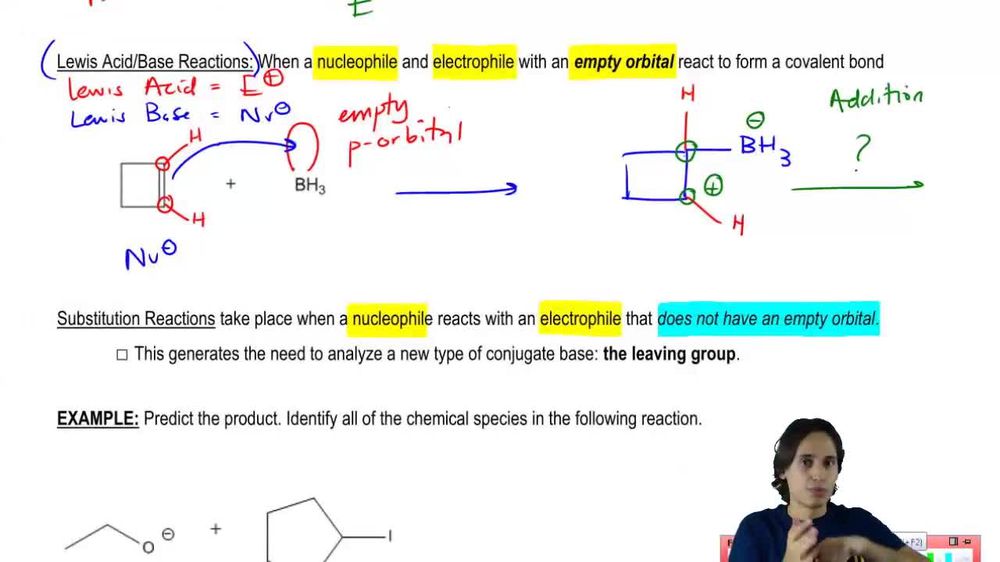
Nucleophilic Substitution Reactions
Nucleophilic substitution reactions involve the replacement of a leaving group in a molecule by a nucleophile. In this case, sodium methoxide acts as the nucleophile attacking the carbon atom bonded to the chlorine in cis-1-chloro-2-isopropylcyclopentane. The mechanism (either SN1 or SN2) will influence the stereochemistry of the products formed from each enantiomer.
Nucleophiles and Electrophiles can react in Substitution Reactions.
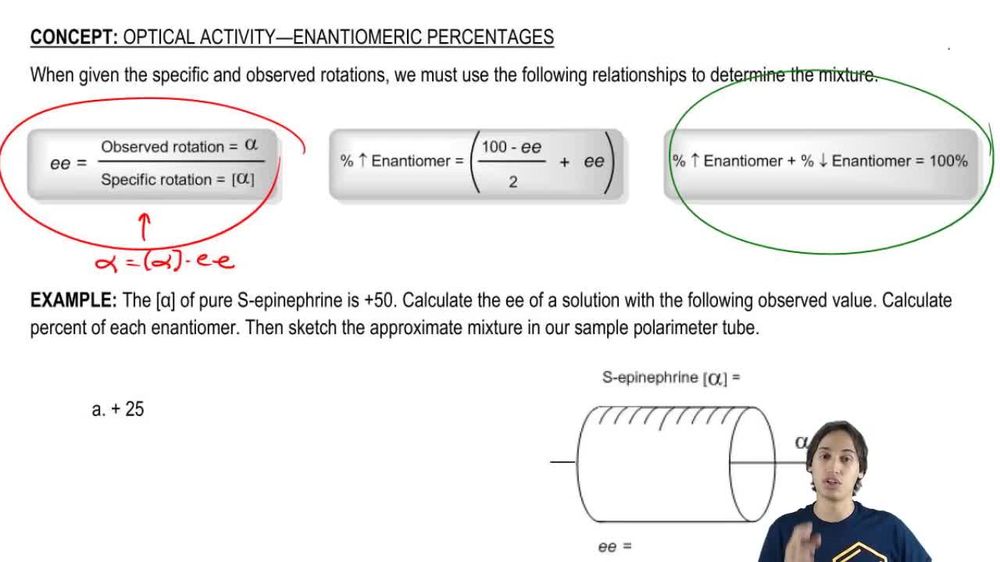
Optical Activity
Optical activity refers to the ability of a chiral compound to rotate the plane of polarized light. A compound is optically active if it lacks an internal plane of symmetry and has a chiral center. In the context of the products formed from the reaction, determining whether they are optically active involves analyzing their structures for chirality and symmetry.

 2:10 minutes
 Verified step by step guidance
 03:23
03:23