Predict the product of the following alkyne reductions. (a)
Verified step by step guidance
1
Step 1: Identify the type of reduction being performed on the alkyne. Common reduction methods include catalytic hydrogenation, Lindlar's catalyst, and dissolving metal reduction. Each method leads to different products.
Step 2: If the reduction is catalytic hydrogenation (using H₂ and a metal catalyst like Pt, Pd, or Ni), the alkyne will be fully reduced to an alkane. This involves the addition of two equivalents of H₂ across the triple bond.
Step 3: If the reduction is performed using Lindlar's catalyst (H₂ with a poisoned catalyst like Pd/CaCO₃), the alkyne will be partially reduced to a cis-alkene. This method selectively adds one equivalent of H₂ to the triple bond, stopping at the alkene stage.
Step 4: If the reduction is a dissolving metal reduction (using Na or Li in liquid NH₃), the alkyne will be partially reduced to a trans-alkene. This method involves electron transfer and protonation steps, leading to the anti-addition of hydrogen atoms.
Step 5: Based on the specific reduction method provided in the problem, predict the product by applying the appropriate mechanism and stereochemistry (cis or trans for alkenes, or fully saturated for alkanes).
Verified video answer for a similar problem:
This video solution was recommended by our tutors as helpful for the problem above
Video duration:
55s
Play a video:
0 Comments
Key Concepts
Here are the essential concepts you must grasp in order to answer the question correctly.
Alkynes
Alkynes are hydrocarbons that contain at least one carbon-carbon triple bond. They are unsaturated compounds and are generally more reactive than alkenes and alkanes due to the presence of the triple bond. Understanding the structure and reactivity of alkynes is crucial for predicting the products of their chemical reactions, including reductions.
Reduction reactions involve the gain of electrons or hydrogen, or the loss of oxygen, resulting in a decrease in oxidation state. In organic chemistry, reducing agents such as hydrogen gas (H2) in the presence of a catalyst or metal hydrides can convert alkynes to alkenes or alkanes. Recognizing the type of reduction and the conditions used is essential for predicting the final product.
Stereochemistry refers to the spatial arrangement of atoms in molecules and how this affects their chemical properties. When reducing alkynes, the stereochemistry of the resulting alkenes can vary, leading to different isomers. Understanding stereochemical outcomes is important for accurately predicting the products of alkyne reductions, especially when considering cis/trans configurations.

 0:55 minutes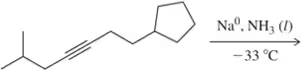
 Verified step by step guidance
 09:11
09:11