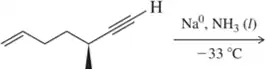
Predict the product of the following alkyne reductions. (b)
Verified step by step guidance
1
Step 1: Identify the type of reduction being performed on the alkyne. Common reduction methods include catalytic hydrogenation, Lindlar's catalyst (partial reduction to cis-alkene), and dissolving metal reduction (partial reduction to trans-alkene). Determine which method is specified in the problem.
Step 2: Recall the mechanism of the chosen reduction method. For example, catalytic hydrogenation with H₂ and a metal catalyst (e.g., Pd, Pt, or Ni) reduces the alkyne completely to an alkane. Lindlar's catalyst reduces the alkyne to a cis-alkene, while dissolving metal reduction (e.g., Na in liquid NH₃) reduces the alkyne to a trans-alkene.
Step 3: Analyze the structure of the starting alkyne. Determine whether it is terminal (one end has a hydrogen) or internal (both ends are substituted). This can influence the stereochemistry and regioselectivity of the product.
Step 4: Apply the reduction method to the alkyne. For example, if Lindlar's catalyst is used, add H₂ to the triple bond in a syn addition manner, resulting in a cis-alkene. If dissolving metal reduction is used, add H atoms in an anti addition manner, resulting in a trans-alkene.
Step 5: Draw the structure of the predicted product based on the stereochemistry and regiochemistry of the reduction method. Ensure that the product matches the expected outcome of the specified reduction process.
Verified video answer for a similar problem:
This video solution was recommended by our tutors as helpful for the problem above
Video duration:
1m
Play a video:
0 Comments
Key Concepts
Here are the essential concepts you must grasp in order to answer the question correctly.
Alkynes
Alkynes are hydrocarbons that contain at least one carbon-carbon triple bond. They are unsaturated compounds and can undergo various reactions, including reductions. Understanding the structure and reactivity of alkynes is crucial for predicting the products of their chemical transformations.
Reduction reactions involve the gain of electrons or the decrease in oxidation state of a molecule. In organic chemistry, this often refers to the addition of hydrogen or the removal of oxygen. For alkynes, reduction can lead to the formation of alkenes or alkanes, depending on the extent of the reduction.
Catalysts are substances that increase the rate of a chemical reaction without being consumed in the process. In the context of alkyne reductions, common catalysts include palladium, platinum, or nickel, which facilitate the addition of hydrogen to the triple bond. The choice of catalyst can influence the selectivity and type of product formed.