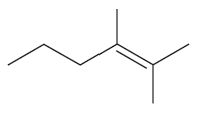
What products are formed when the following compounds react with ozone and then with dimethyl sulfide? a.
Verified step by step guidance
1
Step 1: Recognize that the reaction involves ozonolysis followed by reduction with dimethyl sulfide. Ozonolysis cleaves the double bond in the compound, forming two carbonyl compounds (aldehydes or ketones). Dimethyl sulfide is used to reduce the intermediate ozonide to the final carbonyl products.
Step 2: Identify the double bond in the given compound. The structure shows a double bond between the two central carbon atoms in the molecule. This is the site where ozonolysis will occur.
Step 3: Break the double bond and add oxygen atoms to each carbon involved in the double bond. This forms two fragments, each containing a carbonyl group. Use the structure to determine the substituents attached to each carbon and ensure the correct placement of the carbonyl groups.
Step 4: Analyze the substituents on each fragment to determine whether the products are aldehydes or ketones. If the carbon involved in the double bond is bonded to two other carbons, the product will be a ketone. If it is bonded to one carbon and one hydrogen, the product will be an aldehyde.
Step 5: Write the final products formed after ozonolysis and reduction with dimethyl sulfide. Ensure the products are correctly labeled and match the original substituents from the starting compound.
Verified video answer for a similar problem:
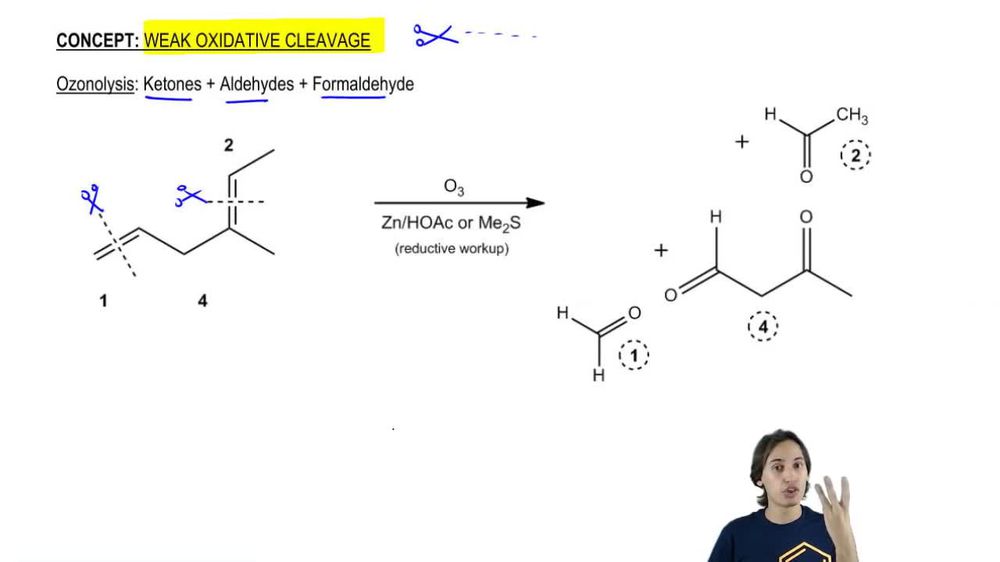
This video solution was recommended by our tutors as helpful for the problem above
Video duration:
3m
Play a video:
0 Comments
Key Concepts
Here are the essential concepts you must grasp in order to answer the question correctly.
Ozonolysis
Ozonolysis is a reaction involving the cleavage of alkenes or alkynes by ozone (O3) to form ozonides, which can then be further processed. This reaction typically results in the formation of carbonyl compounds, such as aldehydes or ketones, depending on the structure of the starting material. Understanding the mechanism of ozonolysis is crucial for predicting the products formed from the reaction of specific compounds.
Dimethyl sulfide (DMS) is often used as a reducing agent in organic reactions, particularly in the workup of ozonolysis. After the formation of ozonides, DMS can reduce these intermediates to yield more stable carbonyl compounds. Recognizing the role of DMS in this context is essential for determining the final products of the reaction sequence.
Functional group transformation refers to the process of converting one functional group into another through chemical reactions. In the context of ozonolysis followed by reduction with DMS, alkenes are transformed into carbonyl-containing compounds. Understanding how different functional groups react and transform is key to predicting the outcomes of organic reactions.