Assign relative priorities to each set of substituents: a. -Br, -I, -OH, -CH3
Verified step by step guidance
1
Step 1: Understand the Cahn-Ingold-Prelog (CIP) priority rules. These rules are used to assign priorities to substituents based on atomic number, isotopic mass, and connectivity. The higher the atomic number, the higher the priority.
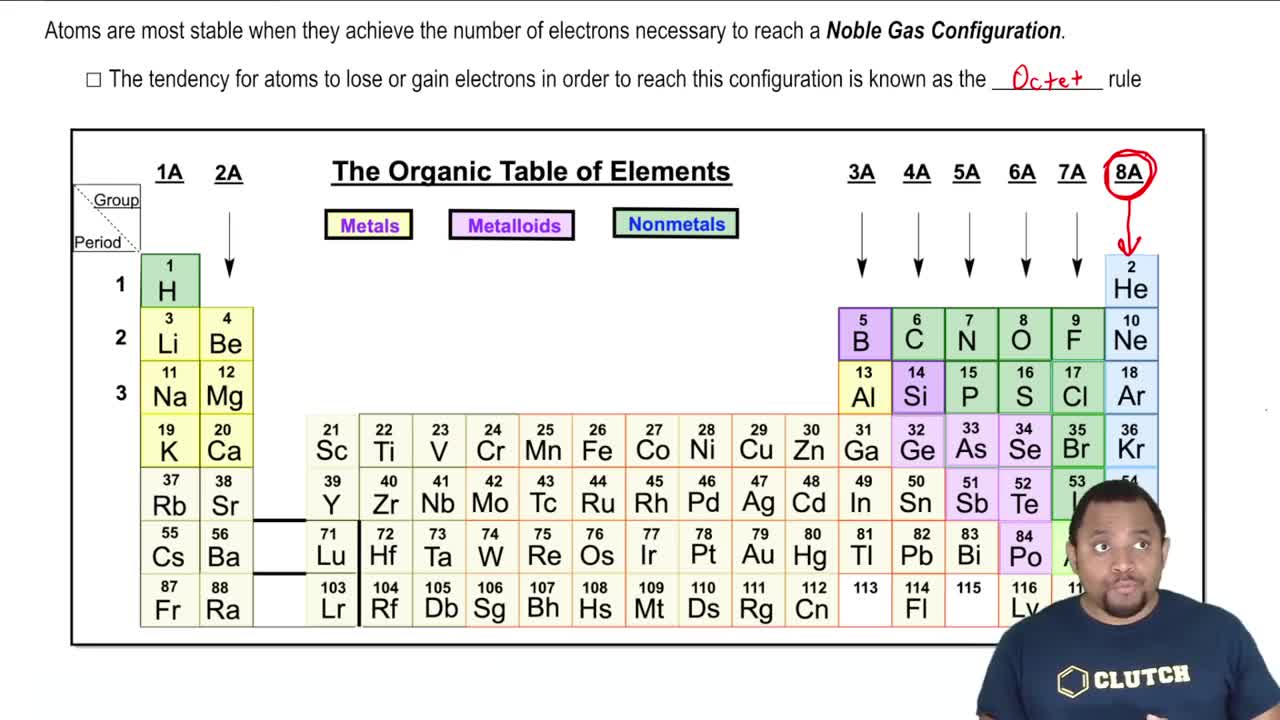
Step 2: Compare the atomic numbers of the atoms directly attached to the carbon. For the given substituents: -Br (atomic number 35), -I (atomic number 53), -OH (oxygen has atomic number 8), and -CH3 (carbon has atomic number 6). Assign priorities based on these atomic numbers.
Step 3: Assign the highest priority to the substituent with the highest atomic number. In this case, iodine (-I) has the highest atomic number (53), so it gets the highest priority.
Step 4: Assign the second highest priority to bromine (-Br), as it has the next highest atomic number (35). Oxygen (-OH) comes next with an atomic number of 8, followed by carbon (-CH3) with an atomic number of 6.
Step 5: Finalize the relative priorities as follows: 1) -I, 2) -Br, 3) -OH, 4) -CH3. These priorities will be used in stereochemical assignments such as R/S configuration or E/Z isomerism.
Verified video answer for a similar problem:
This video solution was recommended by our tutors as helpful for the problem above
Video duration:
2m
Play a video:
0 Comments
Key Concepts
Here are the essential concepts you must grasp in order to answer the question correctly.
Substituent Effects
Substituent effects refer to how different groups attached to a carbon chain influence the reactivity and stability of organic molecules. These effects can be electronic, such as electron-donating or electron-withdrawing properties, or steric, which involves the physical size and spatial arrangement of the substituents. Understanding these effects is crucial for predicting the behavior of molecules in reactions.
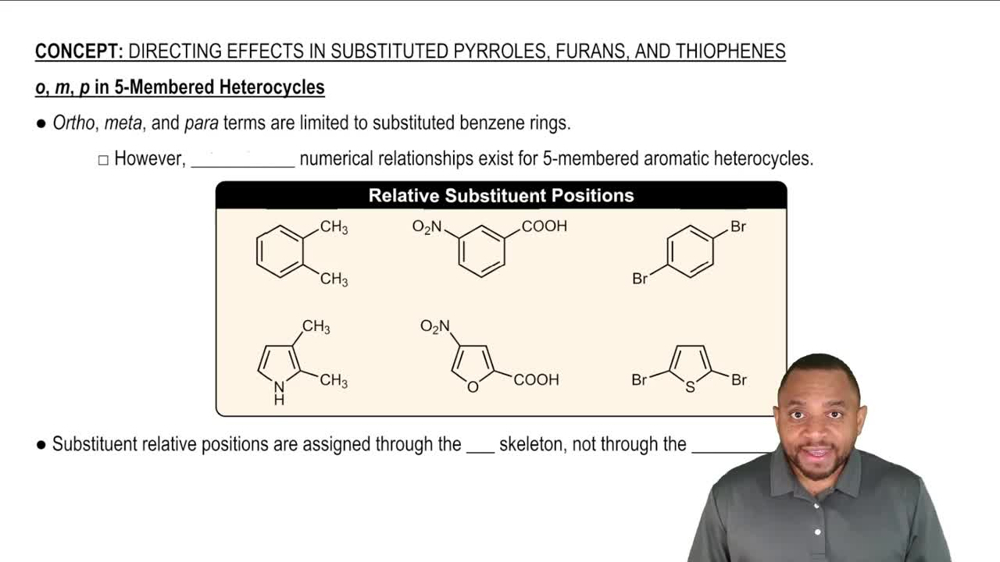
Directing Effects in Substituted Pyrroles, Furans, and Thiophenes Concept 1
Priority Rules in Organic Chemistry
In organic chemistry, priority rules are used to determine the order of substituents based on their atomic number and connectivity. The Cahn-Ingold-Prelog (CIP) priority rules are commonly applied to assign priorities, where higher atomic numbers take precedence. This is essential for understanding stereochemistry and reactivity in substitution reactions.
The most important parts of the periodic table for organic chemistry
Functional Groups
Functional groups are specific groups of atoms within molecules that are responsible for the characteristic chemical reactions of those molecules. In the context of the question, -Br (bromine), -I (iodine), -OH (hydroxyl), and -CH3 (methyl) are all functional groups with distinct properties. Recognizing these groups helps in assigning relative priorities based on their reactivity and influence on the molecular structure.