The IR spectrum for anisole contains two C―O stretching bands in the fingerprint region. Match the band to the bond that gives rise to it. Why are these bands so intense? <IMAGE>
Verified step by step guidance
1
Identify the structure of anisole, which is methoxybenzene, and note that it contains an aromatic ring and a methoxy group (OCH₃) attached to it.
Understand that the C―O stretching vibrations in anisole are due to the methoxy group. There are two types of C―O bonds to consider: the C―O bond within the methoxy group and the C―O bond between the methoxy group and the aromatic ring.
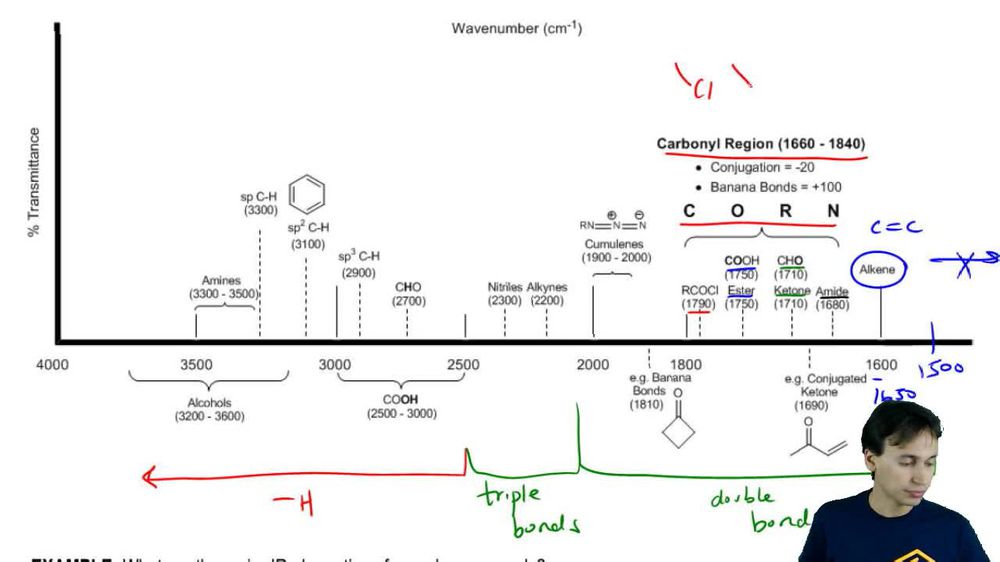
Recognize that the C―O stretching vibrations appear in the IR spectrum in the fingerprint region, typically between 1000 and 1300 cm⁻¹. The two bands correspond to the different environments of the C―O bonds.
The band at the higher frequency is usually attributed to the C―O bond in the methoxy group (OCH₃), as it is more isolated and experiences less resonance stabilization compared to the C―O bond connected to the aromatic ring.
The intensity of these bands is due to the significant change in dipole moment during the C―O bond stretching, which is a characteristic of polar bonds like C―O. The methoxy group contributes to this polarity, enhancing the intensity of the IR absorption bands.
Verified video answer for a similar problem:
This video solution was recommended by our tutors as helpful for the problem above
Play a video:
0 Comments
Key Concepts
Here are the essential concepts you must grasp in order to answer the question correctly.
Infrared Spectroscopy
Infrared spectroscopy is a technique used to identify molecular structures based on their absorption of infrared light. Molecules absorb specific frequencies that correspond to the vibrations of their bonds, creating a spectrum that can be analyzed to determine functional groups and bond types present in the compound.
C―O stretching vibrations refer to the movement of carbon-oxygen bonds within a molecule, which can be detected in the IR spectrum. These vibrations occur in the fingerprint region, typically between 1000 and 1300 cm⁻¹, and are influenced by the bond environment, such as whether the C―O bond is part of an ether or an ester.
The intensity of IR bands is related to the change in dipole moment during the vibration. Bands are more intense when there is a significant change in dipole moment, which occurs in polar bonds like C―O. In anisole, the presence of the methoxy group enhances the dipole moment change, resulting in intense C―O stretching bands.

 Verified step by step guidance
 2:56
2:56