A carboxylic acid can be converted to an ester using the conditions shown. Explain how a comparison of an IR spectrum of the reactant(s) and product can be used to determine whether the reaction was successful or not.
Verified step by step guidance
1
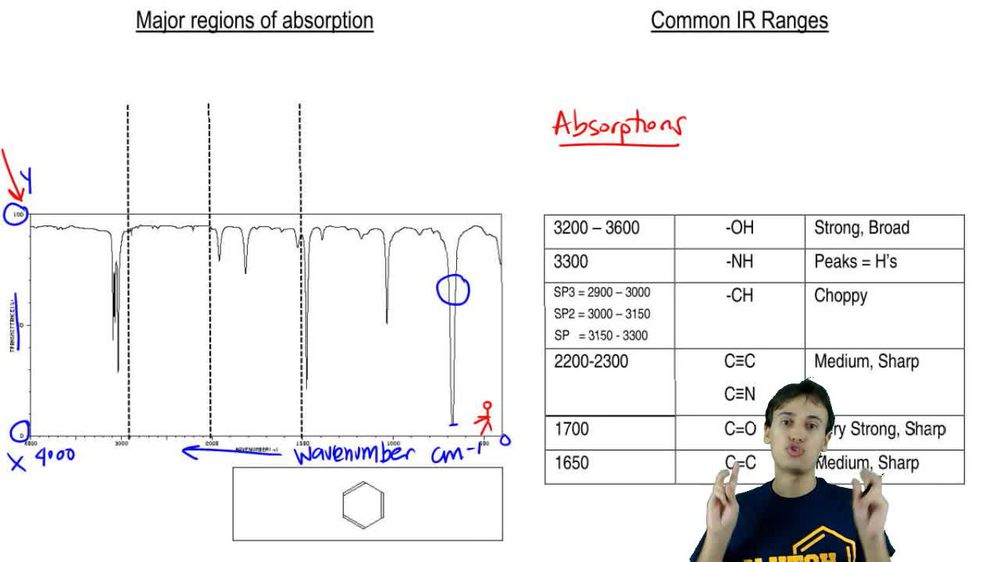
Identify the functional groups present in the reactant (carboxylic acid) and the product (ester). Carboxylic acids have a characteristic C=O stretch around 1700 cm-1 and an O-H stretch around 2500-3300 cm-1 in their IR spectrum.
Recognize that esters have a C=O stretch similar to carboxylic acids, but they lack the broad O-H stretch. Instead, esters show a C-O stretch typically in the range of 1050-1300 cm-1.
Compare the IR spectrum of the reactant with that of the product. Look for the disappearance of the broad O-H stretch in the product's spectrum, which indicates the loss of the carboxylic acid's hydroxyl group.
Check for the presence of the ester C-O stretch in the product's IR spectrum, which should appear as a new peak compared to the reactant's spectrum.
Conclude that the reaction was successful if the IR spectrum of the product shows the disappearance of the O-H stretch and the appearance of the C-O stretch, confirming the conversion of the carboxylic acid to an ester.
Verified video answer for a similar problem:
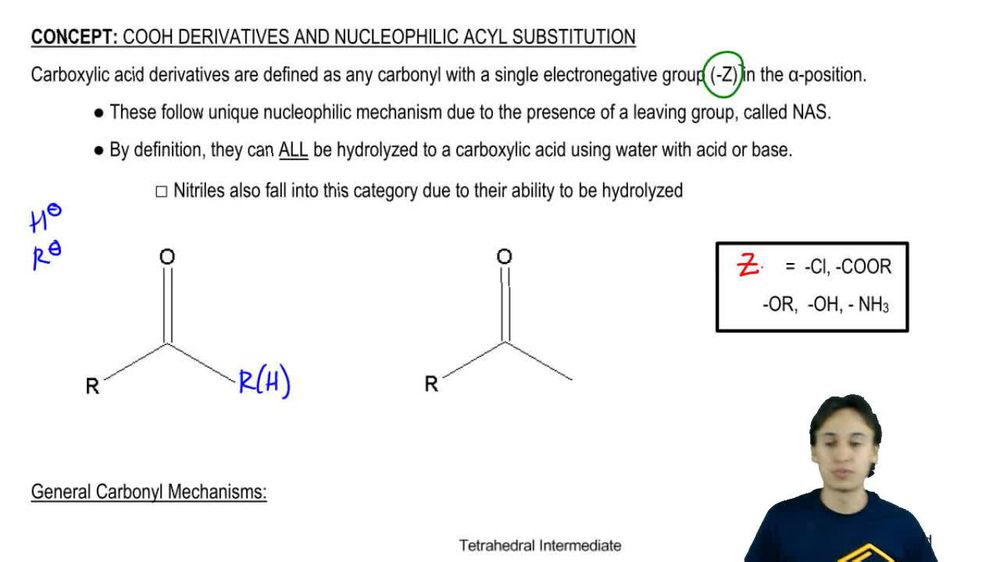
This video solution was recommended by our tutors as helpful for the problem above
Play a video:
0 Comments
Key Concepts
Here are the essential concepts you must grasp in order to answer the question correctly.
Carboxylic Acid to Ester Conversion
The conversion of a carboxylic acid to an ester typically involves a reaction with an alcohol in the presence of an acid catalyst, known as esterification. This process replaces the hydroxyl group (-OH) of the carboxylic acid with an alkoxy group (-OR) from the alcohol, forming an ester and water as byproducts.
IR spectroscopy is a technique used to identify functional groups in organic compounds by measuring the absorption of infrared light. Different functional groups absorb specific frequencies, creating a spectrum that can be analyzed to determine the presence or absence of particular bonds, such as the carbonyl group in carboxylic acids and esters.
In the IR spectrum, carboxylic acids show a broad O-H stretch around 2500-3000 cm⁻¹ and a sharp C=O stretch near 1700 cm⁻¹. Esters, however, lack the O-H stretch and exhibit a C=O stretch around 1735-1750 cm⁻¹. Comparing these spectra allows one to confirm the conversion by the disappearance of the O-H stretch and the shift in the C=O stretch.