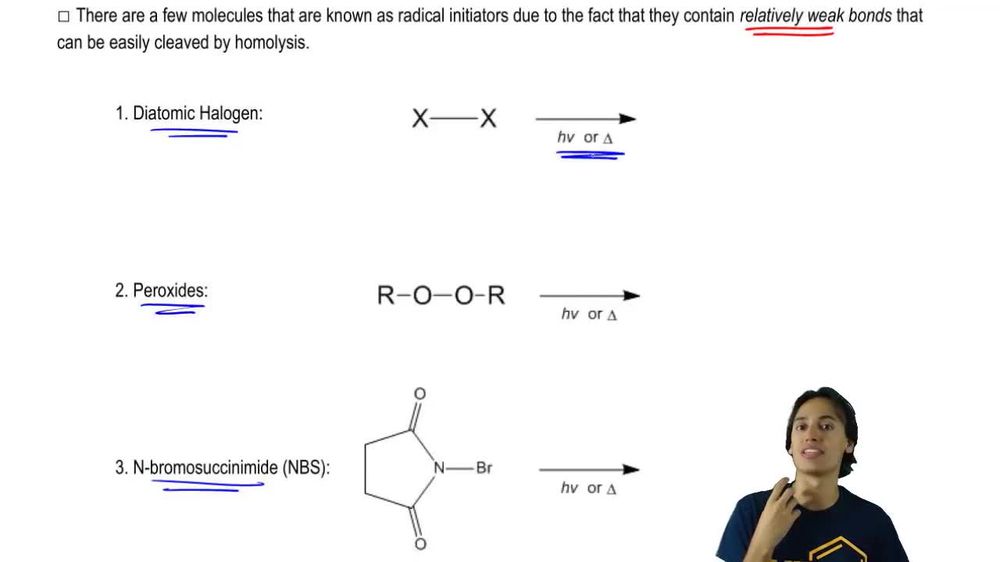
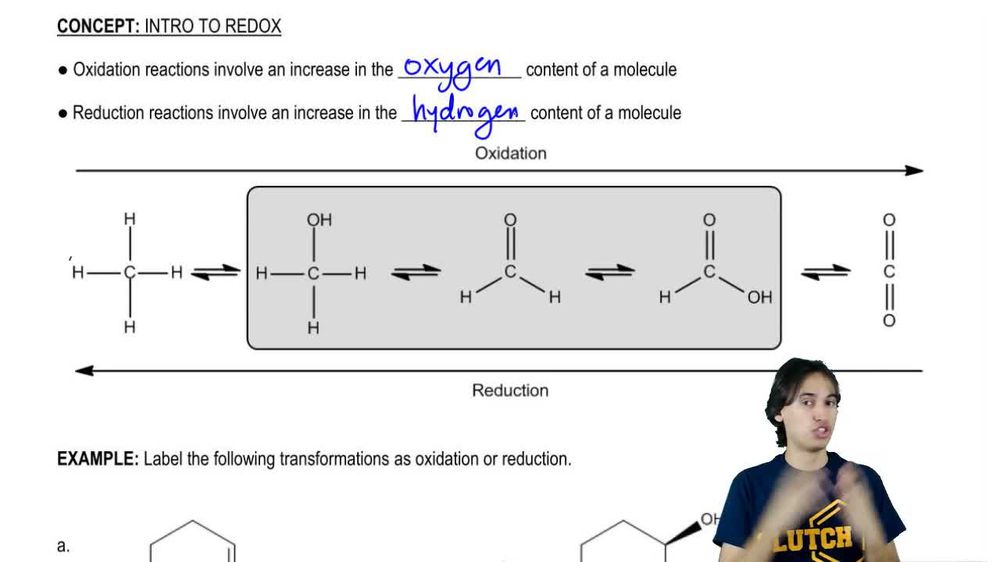
Write an equation for the reaction of vitamin E with an oxidizing radical (RO•) to give ROH and a less reactive free radical.
Verified step by step guidance
1
Step 1: Identify the structure of vitamin E from the provided image. Vitamin E is a phenolic compound with a hydroxyl group (-OH) attached to the aromatic ring, which makes it capable of donating a hydrogen atom to neutralize free radicals.
Step 2: Recognize the oxidizing radical (RO·) in the reaction. This radical is highly reactive and can abstract a hydrogen atom from the hydroxyl group of vitamin E.
Step 3: Write the reaction mechanism. The hydroxyl group of vitamin E donates a hydrogen atom to the oxidizing radical (RO·), forming ROH (an alcohol) and leaving behind a less reactive vitamin E radical.
Step 4: Represent the chemical equation using MathML. The reaction can be written as:
Step 5: Explain the result. The vitamin E radical formed is less reactive and more stable due to resonance stabilization within the aromatic ring. This property allows vitamin E to act as an antioxidant, protecting cells from oxidative damage.
Verified video answer for a similar problem:
This video solution was recommended by our tutors as helpful for the problem above
Video duration:
6m
Play a video:
0 Comments
Key Concepts
Here are the essential concepts you must grasp in order to answer the question correctly.
Vitamin E Structure and Function
Vitamin E, primarily composed of tocopherols and tocotrienols, is a fat-soluble antioxidant that protects cell membranes from oxidative damage. Its structure includes a chromanol ring and a long hydrophobic tail, which allows it to integrate into lipid membranes and scavenge free radicals, thus preventing lipid peroxidation.
Radical reactions involve species with unpaired electrons, known as radicals, which are highly reactive. In the context of the reaction with vitamin E, the oxidizing radical (RO•) can abstract a hydrogen atom from vitamin E, leading to the formation of a less reactive free radical and an alcohol (ROH). Understanding the mechanism of radical formation and stabilization is crucial for predicting the products of such reactions.
Oxidation-reduction reactions involve the transfer of electrons between species, resulting in changes in oxidation states. In this case, vitamin E undergoes oxidation as it donates an electron (or hydrogen atom) to the oxidizing radical, while the radical itself is reduced. Recognizing the roles of oxidizing and reducing agents is essential for balancing redox equations and understanding the overall reaction dynamics.

 6:02 minutes
 Verified step by step guidance
 02:36
02:36