For each reaction, show which stereoisomers are obtained 1. NBS/∆/peroxide 2. Br2/CH2Cl2
Verified step by step guidance
1
Step 1: Understand the context of the reactions. Both reactions involve bromination, but they proceed through different mechanisms. NBS (N-Bromosuccinimide) with heat and peroxide typically leads to allylic bromination, while Br2 in CH2Cl2 results in electrophilic addition to alkenes.
Step 2: For the NBS/∆/peroxide reaction, identify the allylic position in the molecule. The allylic position is the carbon atom adjacent to a double bond. This reaction proceeds via a radical mechanism, where the bromine radical selectively reacts at the allylic position, leading to the formation of allylic bromides.
Step 3: Consider stereoisomer formation in the NBS reaction. Since the reaction involves a radical intermediate, the product may exhibit stereoisomerism depending on the geometry of the double bond and the position of the bromine atom. Analyze the molecule to determine if E/Z isomers or other stereoisomers are possible.
Step 4: For the Br2/CH2Cl2 reaction, understand that this is an electrophilic addition reaction. Bromine adds across the double bond in a syn or anti fashion, depending on the reaction conditions. This typically leads to the formation of vicinal dibromides (two bromine atoms on adjacent carbons).
Step 5: Evaluate stereoisomer formation in the Br2/CH2Cl2 reaction. The addition of bromine can lead to stereoisomers (e.g., enantiomers or diastereomers) depending on the geometry of the starting alkene and the mechanism of bromine addition. Draw the possible stereoisomers based on the molecular structure.
Verified video answer for a similar problem:
This video solution was recommended by our tutors as helpful for the problem above
Video duration:
14m
Play a video:
0 Comments
Key Concepts
Here are the essential concepts you must grasp in order to answer the question correctly.
Stereoisomerism
Stereoisomerism refers to the phenomenon where compounds have the same molecular formula and connectivity of atoms but differ in the spatial arrangement of those atoms. This can lead to different physical and chemical properties. The two main types of stereoisomers are enantiomers, which are non-superimposable mirror images, and diastereomers, which are not mirror images of each other.
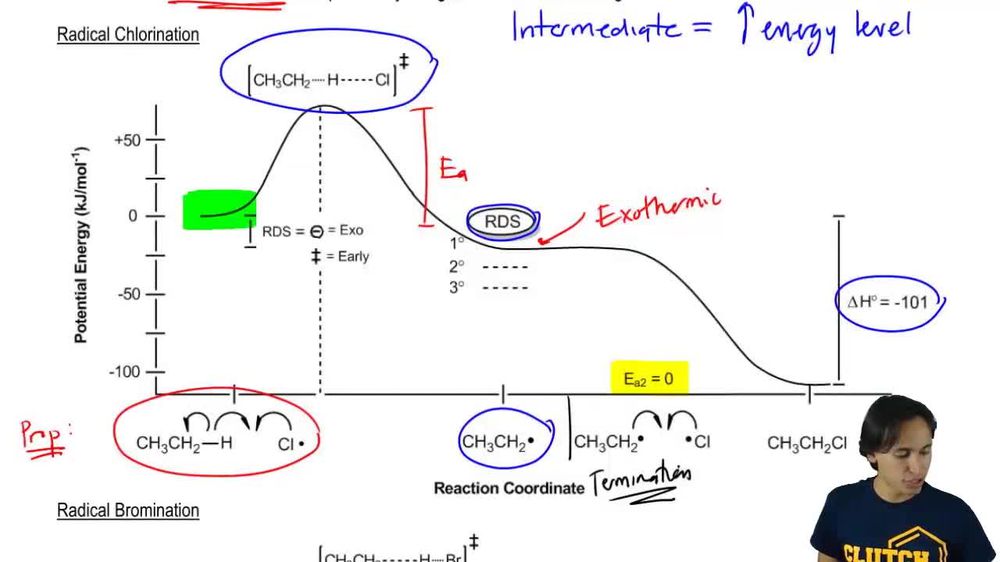
Radical bromination, often initiated by N-bromosuccinimide (NBS) in the presence of heat or light, involves the formation of bromine radicals that abstract hydrogen atoms from alkenes or alkanes. This process can lead to the formation of allylic bromides and can generate different stereoisomers depending on the position of the bromine addition and the nature of the starting material.
Using the Hammond Postulate to describe radical bromination.
Electrophilic Addition
Electrophilic addition is a reaction mechanism where an electrophile reacts with a nucleophile, typically involving alkenes or alkynes. In the case of bromination with Br2 in a non-polar solvent like CH2Cl2, the alkene undergoes addition across the double bond, resulting in vicinal dibromides. The stereochemistry of the addition can lead to the formation of different stereoisomers, including meso compounds and enantiomers.