Show the resonance forms for the enolate ions that result when the following compounds are treated with a strong base. (a) ethyl acetoacetate (b) pentane-2,4-dione
Verified step by step guidance
1
Identify the alpha-hydrogens in the given compounds. Alpha-hydrogens are the hydrogens attached to the carbon atoms adjacent to the carbonyl group. For (a) ethyl acetoacetate, the alpha-hydrogens are on the methylene group between the two carbonyl groups. For (b) pentane-2,4-dione, the alpha-hydrogens are also on the methylene group between the two carbonyl groups.
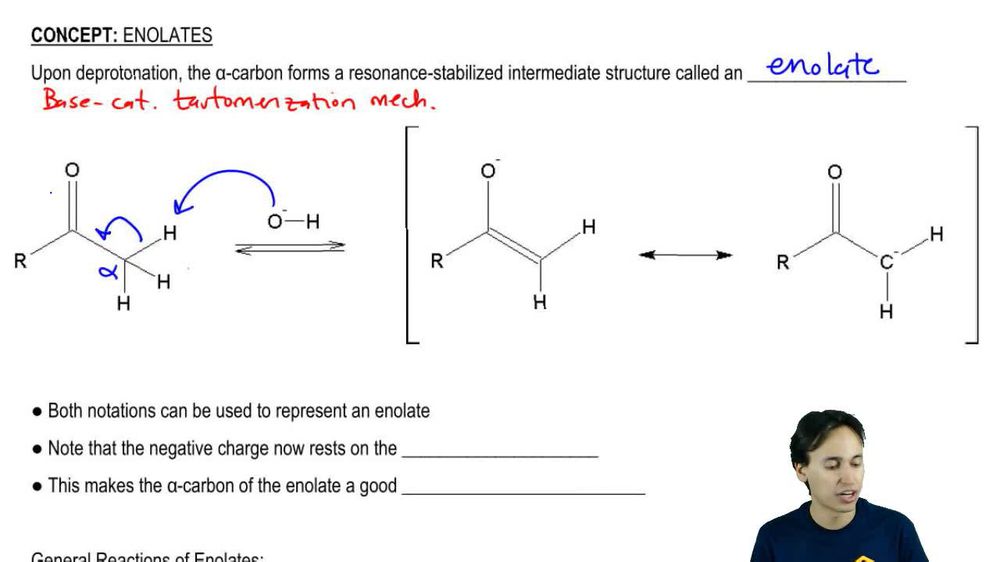
When treated with a strong base, the alpha-hydrogens are deprotonated, forming an enolate ion. The enolate ion is stabilized by resonance because the negative charge can be delocalized between the oxygen atom of the carbonyl group and the alpha-carbon.
Draw the first resonance structure of the enolate ion. For (a) ethyl acetoacetate, this involves placing the negative charge on the oxygen atom of one of the carbonyl groups, with a double bond formed between the alpha-carbon and the adjacent carbonyl carbon. For (b) pentane-2,4-dione, follow the same process.
Draw the second resonance structure of the enolate ion. In this structure, the negative charge is delocalized to the alpha-carbon, and the double bond shifts to the oxygen atom of the carbonyl group. This shows the resonance stabilization of the enolate ion.
Verify that the resonance forms are valid by ensuring that the total number of electrons is conserved and that the octet rule is satisfied for all atoms involved. Resonance structures do not represent separate entities but rather a hybrid of all possible forms.
Verified video answer for a similar problem:
This video solution was recommended by our tutors as helpful for the problem above
Video duration:
9m
Play a video:
0 Comments
Key Concepts
Here are the essential concepts you must grasp in order to answer the question correctly.
Enolate Ion Formation
Enolate ions are formed when a carbonyl compound, such as a ketone or aldehyde, is deprotonated at the alpha carbon by a strong base. This results in a resonance-stabilized anion, where the negative charge can be delocalized between the alpha carbon and the carbonyl oxygen. Understanding this process is crucial for predicting the behavior of compounds like ethyl acetoacetate and pentane-2,4-dione when treated with strong bases.
Resonance structures are different Lewis structures for the same molecule that illustrate the delocalization of electrons. In the case of enolate ions, resonance forms show how the negative charge can be shared between the alpha carbon and the carbonyl oxygen, enhancing the stability of the ion. Recognizing these structures is essential for understanding the reactivity and stability of enolate ions in organic reactions.
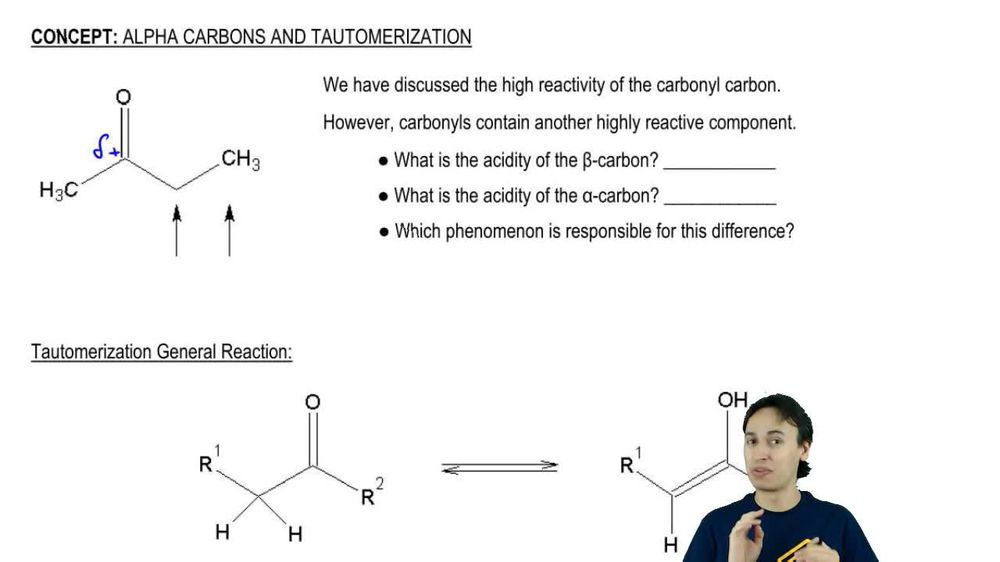
The alpha carbon is the carbon atom adjacent to a carbonyl group and plays a significant role in organic reactions, particularly in enolate chemistry. The acidity of the hydrogen atoms on the alpha carbon allows for the formation of enolate ions, which are key intermediates in various reactions, including aldol condensation and Michael addition. A solid grasp of alpha carbon chemistry is necessary to analyze the behavior of compounds like ethyl acetoacetate and pentane-2,4-dione.

 9:53 minutes
 Verified step by step guidance
 02:26
02:26