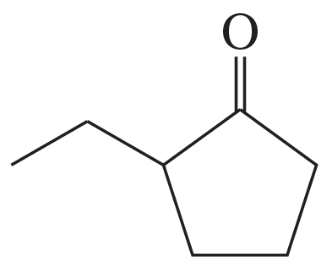
Give the important resonance forms for the possible enolate ions of the following: (d)
Verified step by step guidance
1
Identify the alpha hydrogens in the molecule. Alpha hydrogens are the hydrogens attached to the carbon atoms adjacent to the carbonyl group. In this case, the alpha carbons are the ones directly connected to the carbonyl carbon.
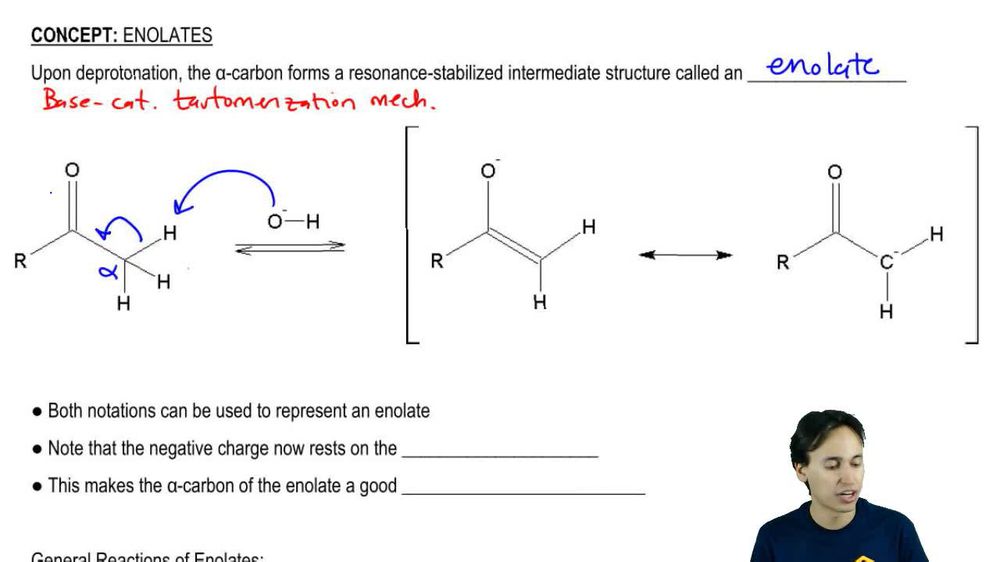
Determine the possible enolate ions that can form by deprotonating the alpha hydrogens. Deprotonation leads to the formation of a carbanion at the alpha carbon, which is stabilized by resonance with the carbonyl group.
Draw the resonance structures for each enolate ion. The negative charge on the alpha carbon can delocalize onto the oxygen atom of the carbonyl group, forming a resonance structure where the oxygen has a negative charge and the alpha carbon has a double bond with the carbonyl carbon.
Consider the stereochemistry and structure of the molecule. The molecule has two distinct alpha carbons (one on the cyclopentane ring and one on the ethyl group). Each alpha carbon can form its own enolate ion, and each enolate ion will have its own set of resonance structures.
Ensure that all resonance structures obey the rules of resonance, such as maintaining the octet rule for all atoms involved and properly delocalizing the electrons. Label the resonance structures to show the movement of electrons and the stabilization of the enolate ion.
Verified video answer for a similar problem:
This video solution was recommended by our tutors as helpful for the problem above
Video duration:
1m
Play a video:
0 Comments
Key Concepts
Here are the essential concepts you must grasp in order to answer the question correctly.
Enolate Ions
Enolate ions are reactive intermediates formed from the deprotonation of a carbonyl compound, typically a ketone or aldehyde. They contain a negatively charged carbon atom adjacent to a carbonyl group, which allows for resonance stabilization. This resonance can lead to different structural forms, influencing the reactivity and stability of the enolate in various organic reactions.
Resonance structures are different Lewis structures for the same molecule that depict the delocalization of electrons. In the case of enolate ions, resonance allows the negative charge to be shared between the carbon atom and the oxygen atom of the carbonyl group. This delocalization stabilizes the enolate ion and is crucial for understanding its reactivity in nucleophilic addition and other reactions.
Carbonyl compounds, characterized by the presence of a carbon-oxygen double bond (C=O), include aldehydes, ketones, and carboxylic acids. They are key substrates in organic chemistry, particularly in reactions involving enolate ions. Understanding the structure and reactivity of carbonyl compounds is essential for predicting the behavior of enolates and their resonance forms in various chemical transformations.