Propose a mechanism for the reaction of aniline with acetic anhydride to give acetanilide.
Verified step by step guidance
1
Step 1: Identify the reactants and the product. The reactants are aniline (C6H5NH2) and acetic anhydride ((CH3CO)2O), and the product is acetanilide (C6H5NHCOCH3). This reaction involves the acetylation of aniline.
Step 2: Recognize the nucleophilic site on aniline. The nitrogen atom in aniline has a lone pair of electrons, making it nucleophilic and capable of attacking the electrophilic carbonyl carbon in acetic anhydride.
Step 3: Initiate the reaction mechanism. The lone pair of electrons on the nitrogen atom of aniline attacks one of the carbonyl carbons in acetic anhydride, forming a tetrahedral intermediate. This step involves nucleophilic addition.
Step 4: Eliminate the leaving group. The tetrahedral intermediate collapses, expelling the acetate ion (CH3COO−) as a leaving group. This step results in the formation of the amide bond between the nitrogen of aniline and the acetyl group.
Step 5: Finalize the product. The reaction yields acetanilide (C6H5NHCOCH3) as the final product, with acetate ion as a byproduct. This is an example of an acylation reaction where aniline is converted into an amide.
Verified video answer for a similar problem:
This video solution was recommended by our tutors as helpful for the problem above
Video duration:
3m
Play a video:
0 Comments
Key Concepts
Here are the essential concepts you must grasp in order to answer the question correctly.
Nucleophilic Acyl Substitution
Nucleophilic acyl substitution is a fundamental reaction mechanism in organic chemistry where a nucleophile attacks an electrophilic carbonyl carbon, leading to the substitution of a leaving group. In the case of aniline reacting with acetic anhydride, the amino group of aniline acts as the nucleophile, attacking the carbonyl carbon of the acetic anhydride, resulting in the formation of acetanilide.
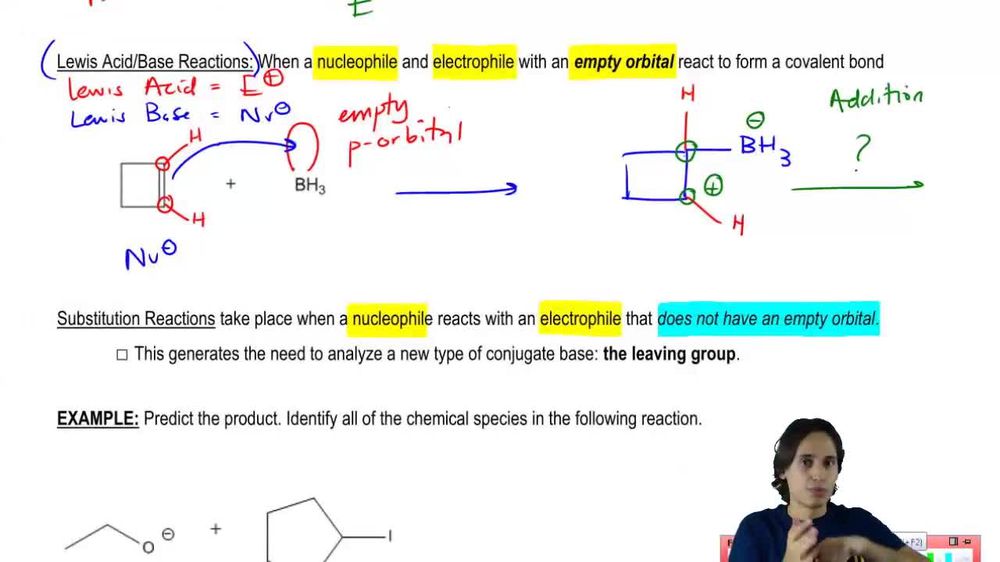
Nucleophiles and Electrophiles can react in Substitution Reactions.
Role of Acetic Anhydride
Acetic anhydride is a reactive acylating agent commonly used in organic synthesis. It provides an acyl group (CH3CO-) that can be transferred to nucleophiles. In this reaction, acetic anhydride not only serves as the source of the acyl group but also facilitates the formation of the amide bond in acetanilide by releasing acetic acid as a byproduct.
Amide formation is a key reaction in organic chemistry where a carboxylic acid or its derivative reacts with an amine to form an amide. In this case, the reaction between aniline and acetic anhydride results in the formation of acetanilide, an amide, through the nucleophilic attack of the aniline nitrogen on the carbonyl carbon of the acetic anhydride, followed by the elimination of acetic acid.