Ch. 6 - The Reactions of Alkenes • The Stereochemistry of Addition Reactions
Bruice - Organic Chemistry 8th Edition
Bruice8th EditionOrganic ChemistryISBN: 9780135213711Not the one you use?Change textbook
Chapter 7, Problem 3a

How many s bond orbitals are available for overlap with the vacant p orbital in
1. the isobutyl cation?
2. the n-butyl cation?
3. the sec-butyl cation?

Verified step by step guidance
1
Step 1: Understand the concept of sigma (σ) bonds and vacant p orbitals. Sigma bonds are formed by the direct overlap of orbitals, and a vacant p orbital is an unoccupied orbital that can potentially overlap with adjacent orbitals. In carbocations, the positively charged carbon has a vacant p orbital.
Step 2: Analyze the structure of the isobutyl cation. The isobutyl cation has a branched structure with the positively charged carbon atom connected to three other carbons. Identify the number of σ bonds directly adjacent to the positively charged carbon that can overlap with the vacant p orbital.
Step 3: Examine the structure of the n-butyl cation. The n-butyl cation has a straight-chain structure with the positively charged carbon atom at the end of the chain. Determine the number of σ bonds adjacent to the positively charged carbon that can overlap with the vacant p orbital.
Step 4: Investigate the structure of the sec-butyl cation. The sec-butyl cation has a secondary carbon as the positively charged center, meaning it is connected to two other carbons and one hydrogen. Count the number of σ bonds adjacent to the positively charged carbon that can overlap with the vacant p orbital.
Step 5: Summarize the findings for each cation. For each structure, the number of σ bonds available for overlap with the vacant p orbital corresponds to the number of atoms directly bonded to the positively charged carbon. This includes both carbon and hydrogen atoms.

Verified video answer for a similar problem:

This video solution was recommended by our tutors as helpful for the problem above.
Video duration:
2m
Was this helpful?

Key Concepts

Here are the essential concepts you must grasp in order to answer the question correctly.

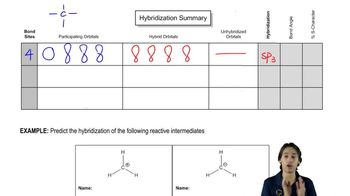
Hybridization

Hybridization is the process by which atomic orbitals mix to form new hybrid orbitals that can accommodate bonding. In organic chemistry, understanding the hybridization of carbon atoms is crucial, as it determines the geometry and types of bonds formed. For example, sp3 hybridization involves one s and three p orbitals, leading to tetrahedral geometry, while sp2 involves one s and two p orbitals, resulting in trigonal planar geometry.
Recommended video:
Guided course
10:43
Using bond sites to predict hybridization

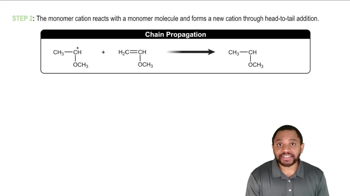
Cation Stability

Cation stability refers to the relative stability of positively charged carbon species, which is influenced by factors such as hybridization and the surrounding substituents. Tertiary cations are generally more stable than secondary or primary cations due to hyperconjugation and inductive effects from alkyl groups. This stability affects the reactivity and formation of cations in organic reactions.
Recommended video:
0:52
Cationic Polymerization Concept 3

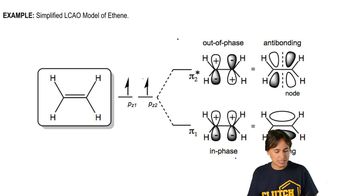
Orbital Overlap

Orbital overlap is the concept that describes how atomic orbitals combine to form bonds in molecules. In the context of cations, the overlap between s bond orbitals and vacant p orbitals is essential for understanding how these cations can stabilize or react. The extent of overlap influences bond strength and the overall stability of the resulting molecular structure.
Recommended video:
Guided course
08:41
Review of Molecular Orbitals