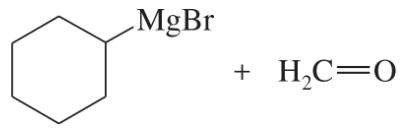
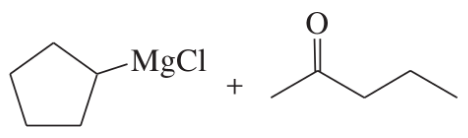
Draw the organic products you would expect to isolate from the following reactions (after hydrolysis). (a) (b)
Verified step by step guidance
1
Step 1: Recognize that the reaction involves a Grignard reagent (R-MgX) reacting with a carbonyl compound. Grignard reagents are nucleophiles that attack electrophilic carbonyl carbons, forming a new carbon-carbon bond.
Step 2: For reaction (a), identify the reactants: cyclohexylmagnesium bromide (Grignard reagent) and formaldehyde (H₂C=O). The Grignard reagent will attack the carbonyl carbon of formaldehyde, leading to the formation of a primary alcohol after hydrolysis.
Step 3: For reaction (b), identify the reactants: cyclopentylmagnesium chloride (Grignard reagent) and butanone (CH₃CH₂COCH₃). The Grignard reagent will attack the carbonyl carbon of butanone, leading to the formation of a tertiary alcohol after hydrolysis.
Step 4: After the nucleophilic attack, the intermediate alkoxide ion is formed. Hydrolysis (addition of water or acid workup) converts the alkoxide ion into the corresponding alcohol.
Step 5: Draw the organic products: (a) Cyclohexylmethanol (a primary alcohol) and (b) 1-cyclopentyl-2-methyl-2-butanol (a tertiary alcohol). Ensure the correct placement of the hydroxyl group and the new carbon-carbon bond in each product.
Verified video answer for a similar problem:
This video solution was recommended by our tutors as helpful for the problem above
Video duration:
5m
Play a video:
0 Comments
Key Concepts
Here are the essential concepts you must grasp in order to answer the question correctly.
Hydrolysis
Hydrolysis is a chemical reaction involving the breaking of a bond in a molecule using water. In organic chemistry, it often refers to the conversion of esters, amides, or other functional groups into their corresponding acids and alcohols or amines. Understanding hydrolysis is crucial for predicting the products of reactions, especially when water is involved in the reaction mechanism.
A reaction mechanism is a step-by-step description of how reactants transform into products during a chemical reaction. It includes the sequence of bond-breaking and bond-forming events, which helps in predicting the structure of the products. Familiarity with common mechanisms, such as nucleophilic substitution or elimination, is essential for accurately drawing the expected organic products.
Functional groups are specific groups of atoms within molecules that are responsible for the characteristic chemical reactions of those molecules. Identifying functional groups in the reactants is vital for predicting the outcome of reactions, as they dictate how the molecule will behave during hydrolysis and what products will be formed. Common functional groups include alcohols, carboxylic acids, and amines.