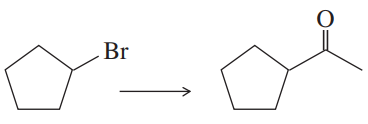
Show how you would accomplish the following synthetic conversions by adding an organolithium reagent to an acid. (b)
Verified step by step guidance
1
Step 1: Begin by converting the alkyl bromide (cyclopentyl bromide) into an organolithium reagent. This can be achieved by reacting cyclopentyl bromide with metallic lithium in a dry, inert solvent such as hexane or ether. The reaction forms cyclopentyllithium.
Step 2: Prepare the acid that will react with the organolithium reagent. In this case, the acid should be acetic acid (CH₃COOH), as the target molecule contains a ketone group derived from acetic acid.
Step 3: Add the cyclopentyllithium reagent to acetic acid. The organolithium reagent acts as a nucleophile and attacks the carbonyl carbon of acetic acid, forming an intermediate.
Step 4: Allow the intermediate to undergo proton transfer and rearrangement. This step leads to the formation of the desired ketone product, cyclopentanone.
Step 5: Purify the product using standard organic chemistry techniques such as distillation or recrystallization to isolate the cyclopentanone.
Verified video answer for a similar problem:
This video solution was recommended by our tutors as helpful for the problem above
Video duration:
3m
Play a video:
0 Comments
Key Concepts
Here are the essential concepts you must grasp in order to answer the question correctly.
Organolithium Reagents
Organolithium reagents are highly reactive compounds containing a carbon-lithium bond. They act as strong nucleophiles and are commonly used in organic synthesis to form carbon-carbon bonds. In the context of the question, they can react with electrophiles, such as carbonyl compounds, to facilitate the conversion of halogenated cyclic compounds into more complex structures.
Nucleophilic substitution is a fundamental reaction mechanism in organic chemistry where a nucleophile replaces a leaving group in a molecule. In this case, the organolithium reagent acts as the nucleophile, attacking the carbon atom bonded to the bromine atom, leading to the formation of a new carbon-carbon bond and the release of bromide ion as a leaving group.
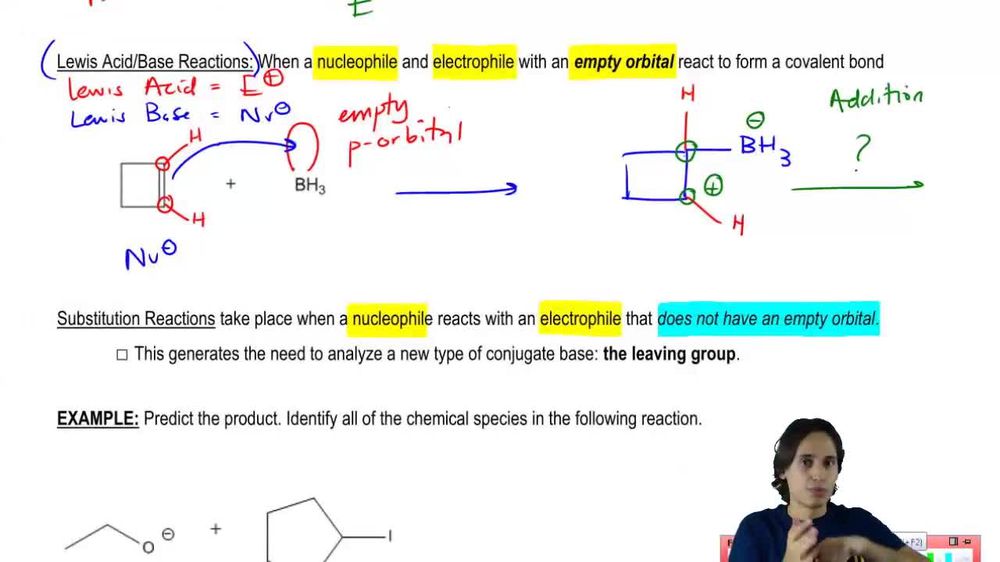
Nucleophiles and Electrophiles can react in Substitution Reactions.
Formation of Carbonyl Compounds
The formation of carbonyl compounds involves the introduction of a carbonyl functional group (C=O) into a molecule. In the given reaction, the organolithium reagent adds to the cyclic compound, followed by a reaction with an acid to convert the resulting intermediate into a stable carbonyl compound. This transformation is crucial in organic synthesis for creating various functionalized molecules.