Ch. 15 - Reactions of Carboxylic Acids and Carboxylic Acid Derivatives
Bruice - Organic Chemistry 8th Edition
Bruice8th EditionOrganic ChemistryISBN: 9780135213711Not the one you use?Change textbook
Chapter 16, Problem 91a

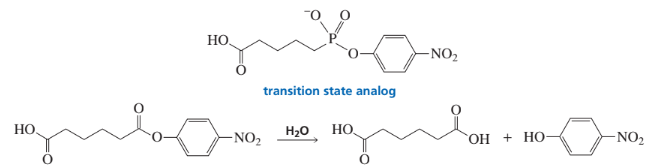
Catalytic antibodies catalyze a reaction by forcing the conformation of the substrate in the direction of the transition state. The synthesis of the antibody is carried out in the presence of a transition state analog—a stable molecule that structurally resembles the transition state. This causes an antibody to be generated that recognizes and binds to the transition state, thereby stabilizing it. For example, the following transition state analog has been used to ­generate a catalytic antibody that catalyzes the hydrolysis of the structurally similar ester:
Chemical structures illustrating a transition state analog and its role in hydrolysis reactions.
a. Draw a possible transition state for the hydrolysis reaction.

Verified step by step guidance
1
Understand the concept of a transition state: A transition state is a high-energy, unstable arrangement of atoms that occurs during a chemical reaction. It represents the point at which bonds are partially broken and/or formed. In this case, the hydrolysis of an ester involves breaking the bond between the carbonyl carbon and the leaving group, while forming a bond with a nucleophile (water).
Identify the key features of the ester hydrolysis reaction: The reaction involves a nucleophilic attack by water on the carbonyl carbon of the ester, leading to the formation of a tetrahedral intermediate. This intermediate is the transition state analog that the catalytic antibody stabilizes.
Draw the transition state: Represent the carbonyl carbon as partially bonded to both the nucleophile (water) and the leaving group. Use dashed lines to indicate partial bonds, and include partial charges to show the redistribution of electron density. For example, the carbonyl oxygen will have a partial negative charge, and the carbonyl carbon will have a partial positive charge.
Incorporate the transition state analog: The transition state analog mimics the geometry and electronic structure of the actual transition state but is stable. It typically includes a tetrahedral geometry around the carbonyl carbon and may have groups that resemble the nucleophile and leaving group.
Verify the structure: Ensure that the drawn transition state includes all necessary features, such as partial bonds, charges, and the correct geometry. This will help in understanding how the catalytic antibody stabilizes the transition state and facilitates the reaction.

Verified video answer for a similar problem:

This video solution was recommended by our tutors as helpful for the problem above.
Was this helpful?

Key Concepts

Here are the essential concepts you must grasp in order to answer the question correctly.

Transition State Theory

Transition State Theory posits that during a chemical reaction, reactants pass through a high-energy transition state before forming products. This state represents the point of maximum energy along the reaction pathway, where bonds are partially broken and formed. Understanding this concept is crucial for visualizing how substrates are converted into products and how catalysts can stabilize this state to lower the activation energy required for the reaction.
Recommended video:
Guided course
06:55
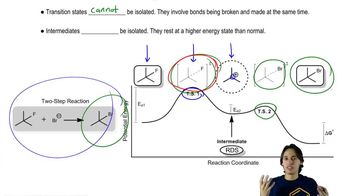
Intermediates vs. Transition States

Catalytic Antibodies

Catalytic antibodies, or abzymes, are antibodies engineered to catalyze specific chemical reactions. They are produced by immunizing an organism with a transition state analog, which mimics the transition state of the target reaction. This process leads to the generation of antibodies that bind to the transition state, enhancing the reaction rate by stabilizing this high-energy configuration, thus facilitating the conversion of substrates into products.
Recommended video:
3:21
Catalytic Allylic Alkylation Concept 1

Transition State Analog

A transition state analog is a stable molecule that closely resembles the transition state of a chemical reaction. It is used in the design of catalytic antibodies to elicit an immune response that produces antibodies capable of binding to the transition state. By mimicking the transition state, these analogs help researchers understand the reaction mechanism and develop effective catalysts that can lower activation energy and increase reaction rates.
Recommended video:
Guided course
06:55
Intermediates vs. Transition States