Ch. 21 - Amino Acids, Peptides, and Proteins
Bruice - Organic Chemistry 8th Edition
Bruice8th EditionOrganic ChemistryISBN: 9780135213711Not the one you use?Change textbook
Chapter 22, Problem 23a

What alkyl halide is used in the acetamidomalonic ester synthesis to prepare
a. lysine?

Verified step by step guidance
1
Step 1: Understand the acetamidomalonic ester synthesis. This method is used to synthesize α-amino acids by alkylating the acetamidomalonic ester intermediate. The process involves selecting an appropriate alkyl halide to introduce the desired side chain.
Step 2: Analyze the structure of lysine. Lysine is an α-amino acid with the molecular formula C6H14N2O2. It contains a primary amino group (-NH2) and a side chain with a four-carbon chain ending in another amino group (-CH2CH2CH2CH2NH2).
Step 3: Determine the alkyl halide needed to introduce the lysine side chain. To form the four-carbon chain in lysine, the alkyl halide should contain a four-carbon chain with a terminal functional group that can be modified later to introduce the amino group.
Step 4: Select the appropriate alkyl halide. The alkyl halide used in this synthesis is typically 4-bromobutylamine (BrCH2CH2CH2CH2NH2), as it provides the necessary four-carbon chain with a terminal amino group.
Step 5: Outline the reaction mechanism. The acetamidomalonic ester is first deprotonated to form a nucleophilic enolate ion, which then reacts with the alkyl halide (4-bromobutylamine) via an SN2 mechanism to introduce the lysine side chain. Subsequent hydrolysis and decarboxylation steps yield lysine.

Verified video answer for a similar problem:

This video solution was recommended by our tutors as helpful for the problem above.
Video duration:
5m
Was this helpful?

Key Concepts

Here are the essential concepts you must grasp in order to answer the question correctly.

Alkyl Halides

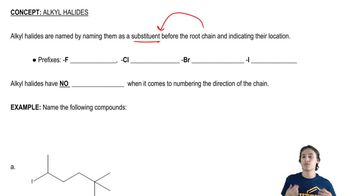
Alkyl halides are organic compounds containing a carbon atom bonded to a halogen atom (F, Cl, Br, I). They are important in organic synthesis as they can undergo nucleophilic substitution reactions, where the halogen is replaced by a nucleophile. In the context of acetamidomalonic ester synthesis, the choice of alkyl halide affects the structure and properties of the final product, lysine.
Recommended video:
Guided course
01:52
How to name alkyl halides

Acetamidomalonic Ester Synthesis

Acetamidomalonic ester synthesis is a method used to synthesize amino acids, particularly lysine. This reaction involves the use of acetamidomalonic ester, which undergoes a series of reactions including alkylation and hydrolysis. Understanding this synthesis pathway is crucial for identifying the appropriate alkyl halide that will yield lysine as the final product.
Recommended video:
01:28
Synthesis of Amino Acids: Acetamidomalonic Ester Synthesis Example 2

Nucleophilic Substitution

Nucleophilic substitution is a fundamental reaction mechanism in organic chemistry where a nucleophile attacks an electrophilic carbon atom, resulting in the replacement of a leaving group, such as a halogen. This mechanism is key in the reaction of alkyl halides in the acetamidomalonic ester synthesis, as it determines how the alkyl halide interacts with the ester to form the desired amino acid.
Recommended video:
Guided course
01:47
Nucleophiles and Electrophiles can react in Substitution Reactions.