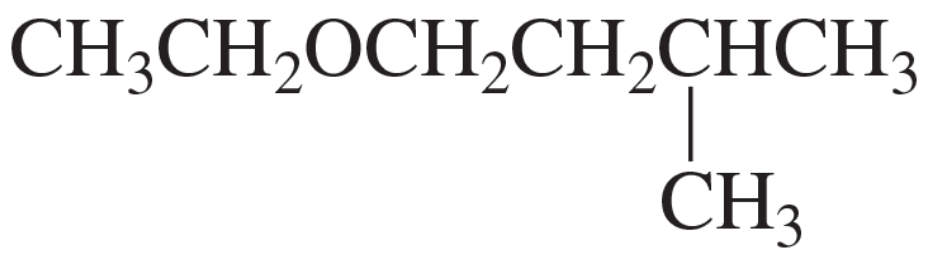
Give two sets of reactants (each set including an alkyl halide and a nucleophile) that could be used to synthesize the following ether:
Verified step by step guidance
1
Step 1: Analyze the ether structure provided. The ether has two alkyl groups attached to the oxygen atom: one is a tert-butyl group (C(CH3)3), and the other is an isopropyl group (CH(CH3)2). This indicates that the ether can be synthesized using two different sets of reactants: an alkyl halide and a nucleophile.
Step 2: Recall the Williamson Ether Synthesis mechanism. This reaction involves an alkoxide ion (nucleophile) reacting with an alkyl halide via an SN2 mechanism to form an ether. The alkoxide ion is typically generated by deprotonating an alcohol with a strong base.
Step 3: For the first set of reactants, choose tert-butyl bromide (C(CH3)3Br) as the alkyl halide and isopropoxide ion (CH(CH3)2O⁻) as the nucleophile. The isopropoxide ion can be prepared by treating isopropanol (CH(CH3)2OH) with a strong base like NaH or NaOH.
Step 4: For the second set of reactants, choose isopropyl bromide (CH(CH3)2Br) as the alkyl halide and tert-butoxide ion (C(CH3)3O⁻) as the nucleophile. The tert-butoxide ion can be prepared by treating tert-butanol (C(CH3)3OH) with a strong base like NaH or NaOH.
Step 5: Ensure that the chosen alkyl halide and nucleophile pair avoids steric hindrance issues during the SN2 reaction. For example, the tert-butoxide ion is bulky, so it is better used as the nucleophile when reacting with a less hindered alkyl halide like isopropyl bromide.
Verified video answer for a similar problem:
This video solution was recommended by our tutors as helpful for the problem above
Video duration:
2m
Play a video:
0 Comments
Key Concepts
Here are the essential concepts you must grasp in order to answer the question correctly.
Williamson Ether Synthesis
Williamson Ether Synthesis is a method for creating ethers through the reaction of an alkoxide ion with a primary alkyl halide. This reaction involves nucleophilic substitution, where the alkoxide acts as a nucleophile, attacking the electrophilic carbon of the alkyl halide, leading to the formation of an ether. The choice of reactants is crucial, as steric hindrance can affect the reaction's success.
Alkyl halides are organic compounds containing a carbon atom bonded to a halogen atom (such as chlorine, bromine, or iodine). They serve as electrophiles in nucleophilic substitution reactions, making them essential reactants in ether synthesis. The structure of the alkyl halide, particularly whether it is primary, secondary, or tertiary, influences the reaction pathway and the feasibility of the Williamson Ether Synthesis.
Nucleophiles are species that donate an electron pair to form a chemical bond in a reaction. In the context of ether synthesis, nucleophiles such as alkoxides or amines are crucial as they attack the electrophilic carbon of alkyl halides. The strength and structure of the nucleophile can significantly affect the reaction rate and the selectivity of the ether formation.