Ch. 9 - Substitution and Elimination Reactions of Alkyl Halides
Bruice - Organic Chemistry 8th Edition
Bruice8th EditionOrganic ChemistryISBN: 9780135213711Not the one you use?Change textbook
Chapter 10, Problem 61a,b

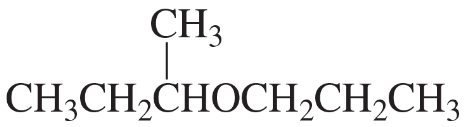
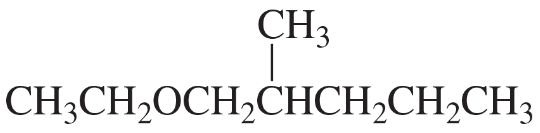
What is the best way to prepare the following ethers using an alkyl halide and an alkoxide ion?
a.
b.

Verified step by step guidance
1
Step 1: Recognize that the synthesis of ethers using an alkyl halide and an alkoxide ion is typically achieved through the Williamson Ether Synthesis. This reaction involves an SN2 mechanism, where the alkoxide ion acts as a nucleophile and the alkyl halide acts as an electrophile.
Step 2: Analyze the ether structure provided. The ether has two alkyl groups attached to the oxygen atom. One group is a tert-butyl group (on the left), and the other is a 2,2-dimethylpropyl group (on the right). Decide which part will come from the alkoxide ion and which from the alkyl halide.
Step 3: Consider steric hindrance. The SN2 mechanism requires a less sterically hindered alkyl halide for the reaction to proceed efficiently. The 2,2-dimethylpropyl group is highly hindered, so it is better to use the tert-butoxide ion (tert-butyl group) as the alkoxide and the 2,2-dimethylpropyl group as the alkyl halide.
Step 4: Write the reaction. Use tert-butoxide ion (\( \text{(CH}_3\text{)}_3\text{CO}^- \)) as the nucleophile and 2,2-dimethylpropyl bromide (\( \text{(CH}_3\text{)}_3\text{CCH}_2\text{Br} \)) as the electrophile. The reaction proceeds via an SN2 mechanism to form the desired ether.
Step 5: Ensure the reaction conditions are suitable. Use a polar aprotic solvent (e.g., DMSO or acetone) to facilitate the SN2 reaction and avoid side reactions. Heat may be applied if necessary to drive the reaction to completion.

Verified video answer for a similar problem:

This video solution was recommended by our tutors as helpful for the problem above.
Video duration:
3m
Was this helpful?

Key Concepts

Here are the essential concepts you must grasp in order to answer the question correctly.

Williamson Ether Synthesis

Williamson Ether Synthesis is a method for preparing ethers by reacting an alkoxide ion with a primary alkyl halide. The alkoxide acts as a nucleophile, attacking the electrophilic carbon of the alkyl halide, leading to the formation of an ether. This reaction is particularly effective with primary halides to minimize steric hindrance and avoid elimination reactions.
Recommended video:
Guided course
03:50
The Mechanism of Williamson Ether Synthesis.

Alkoxide Ion

An alkoxide ion is a deprotonated alcohol, represented as R-O⁻, where R is an alkyl group. Alkoxides are strong nucleophiles and are commonly used in ether synthesis due to their ability to effectively attack electrophiles. They can be generated by treating alcohols with strong bases, such as sodium hydride or sodium metal.
Recommended video:
3:39
Metal Ion Catalysis Concept 1

Nucleophilicity and Electrophilicity

Nucleophilicity refers to the ability of a species to donate an electron pair to form a chemical bond, while electrophilicity is the ability of a species to accept an electron pair. In the context of ether synthesis, the alkoxide ion is the nucleophile that attacks the electrophilic carbon of the alkyl halide, facilitating the formation of the ether product.
Recommended video:
Guided course
03:
Nucleophile or Electrophile