Predict the products formed when cyclohexanone reacts with the following reagents. (i) hydrazine, then hot, fused KOH
Verified step by step guidance
1
Step 1: Recognize the reaction type. This reaction is known as the Wolff-Kishner reduction, which involves the reduction of a carbonyl group (C=O) to a methylene group (CH₂) using hydrazine (NH₂NH₂) and a strong base like KOH under high-temperature conditions.
Step 2: Write the structure of cyclohexanone. Cyclohexanone is a six-membered cyclic ketone with a carbonyl group (C=O) attached to one of the carbons in the ring.
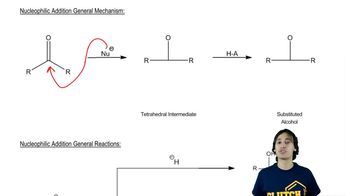
Step 3: Understand the role of hydrazine. Hydrazine reacts with the carbonyl group of cyclohexanone to form a hydrazone intermediate. The reaction involves nucleophilic attack by the nitrogen of hydrazine on the carbonyl carbon, followed by the elimination of water.
Step 4: Analyze the role of hot, fused KOH. Under high-temperature conditions, the hydrazone intermediate undergoes a base-catalyzed decomposition, leading to the removal of the nitrogen atoms as nitrogen gas (N₂). This results in the reduction of the carbonyl group to a methylene group (CH₂).
Step 5: Predict the final product. The carbonyl group in cyclohexanone is completely reduced, and the product is cyclohexane, a six-membered ring with no double bonds or functional groups.
Verified video answer for a similar problem:
This video solution was recommended by our tutors as helpful for the problem above
Video duration:
2m
Play a video:
0 Comments
Key Concepts
Here are the essential concepts you must grasp in order to answer the question correctly.
Cyclohexanone Reactivity
Cyclohexanone is a cyclic ketone that can undergo various reactions due to its carbonyl group. The carbonyl carbon is electrophilic, making it susceptible to nucleophilic attack. Understanding its reactivity is crucial for predicting the products formed in reactions with reagents like hydrazine.
Hydrazine (N2H4) acts as a nucleophile and can react with carbonyl compounds to form hydrazones. This reaction involves the nucleophilic attack of hydrazine on the carbonyl carbon, followed by dehydration to yield a stable hydrazone product. Recognizing this mechanism is essential for predicting the initial product in the reaction.
Hot, fused KOH can facilitate dehydrogenation reactions, particularly in the presence of hydrazones. This process typically involves the elimination of nitrogen gas and the formation of alkenes or other unsaturated compounds. Understanding this step is key to predicting the final products after the initial reaction with hydrazine.