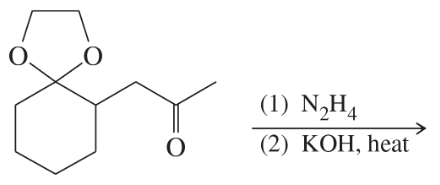
Predict the major products of the following reactions: (c)
Verified step by step guidance
1
Step 1: Identify the reaction type. The reagents used are hydrazine (H₂NNH₂) followed by potassium hydroxide (KOH) and heat. This combination is characteristic of the Wolff-Kishner reduction, which is used to reduce carbonyl groups (such as ketones or aldehydes) to methylene groups (-CH₂-).
Step 2: Analyze the structure of the starting material. The molecule contains a ketone functional group attached to a cyclopentane ring. Additionally, there is a bicyclic structure with two ether groups forming a dioxolane ring.
Step 3: Predict the effect of the Wolff-Kishner reduction. The ketone group will be reduced to a methylene group (-CH₂-) under the reaction conditions, leaving the rest of the molecule unchanged.
Step 4: Consider the stability of the bicyclic dioxolane ring. The reaction conditions (basic medium and heat) are unlikely to affect the ether groups or the dioxolane ring structure, as they are stable under these conditions.
Step 5: Draw the major product. Replace the ketone group in the starting material with a methylene group (-CH₂-) while keeping the bicyclic dioxolane ring and cyclopentane ring intact. This will give the final structure of the major product.
Verified video answer for a similar problem:
This video solution was recommended by our tutors as helpful for the problem above
Video duration:
2m
Play a video:
0 Comments
Key Concepts
Here are the essential concepts you must grasp in order to answer the question correctly.
Wolff-Kishner Reduction
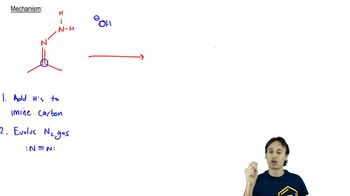
The Wolff-Kishner reduction is a chemical reaction used to convert carbonyl compounds, such as ketones and aldehydes, into alkanes. This process involves the use of hydrazine (H2NNH2) and a strong base, typically potassium hydroxide (KOH), under heating conditions. The reaction proceeds through the formation of a hydrazone intermediate, which is then deprotonated and loses nitrogen gas, resulting in the formation of the corresponding alkane.
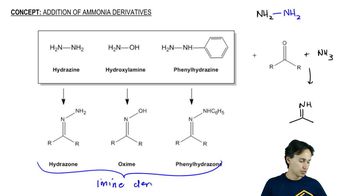
Hydrazine (H2NNH2) is a powerful reducing agent commonly used in organic synthesis. In the context of the Wolff-Kishner reduction, it reacts with carbonyl compounds to form hydrazones, which are crucial intermediates. The nitrogen atoms in hydrazine facilitate the removal of the carbonyl oxygen, ultimately leading to the formation of alkanes after the elimination of nitrogen gas during the reaction.
The reaction conditions for the Wolff-Kishner reduction typically involve heating the reaction mixture in the presence of a strong base like KOH. The heat is essential for driving the reaction to completion, as it promotes the elimination of nitrogen gas from the hydrazone intermediate. Understanding the importance of temperature and base strength is crucial for predicting the success and efficiency of the reduction process.