Propose a mechanism for the reaction of methyl isocyanate with 1-naphthol to give Sevin® insecticide.
Verified step by step guidance
1
Identify the key functional groups in the reactants: Methyl isocyanate (CH3-N=C=O) contains an isocyanate group (-N=C=O), and 1-naphthol contains a hydroxyl group (-OH) attached to a naphthalene ring. These groups are crucial for the reaction mechanism.
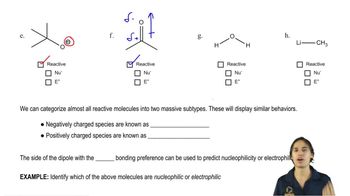
Recognize the nucleophile and electrophile: The hydroxyl group (-OH) of 1-naphthol acts as a nucleophile due to the lone pair of electrons on oxygen, while the carbon atom in the isocyanate group (-N=C=O) is electrophilic due to its partial positive charge.
Propose the first step of the mechanism: The nucleophilic oxygen atom of the hydroxyl group attacks the electrophilic carbon atom of the isocyanate group, forming a tetrahedral intermediate. This step involves the formation of a new C-O bond.
Describe the rearrangement: The tetrahedral intermediate undergoes rearrangement, where the nitrogen atom (N) of the isocyanate group facilitates the elimination of the oxygen atom (O) as part of a leaving group, forming a carbamate linkage (-NH-COO-).
Conclude the mechanism: The final product is Sevin® insecticide, which contains a carbamate functional group (-NH-COO-) attached to the naphthalene ring. This structure is stabilized by resonance and is the desired product of the reaction.
Verified video answer for a similar problem:
This video solution was recommended by our tutors as helpful for the problem above
Video duration:
9m
Play a video:
0 Comments
Key Concepts
Here are the essential concepts you must grasp in order to answer the question correctly.
Isocyanate Reactivity
Isocyanates are highly reactive compounds that can undergo nucleophilic addition reactions. In the case of methyl isocyanate, the carbon atom is electrophilic due to the presence of the electron-withdrawing isocyanate group. This reactivity allows isocyanates to react with nucleophiles, such as alcohols or amines, forming stable adducts.
Nucleophilic aromatic substitution (NAS) is a reaction mechanism where a nucleophile replaces a leaving group on an aromatic ring. In this context, 1-naphthol can act as a nucleophile due to its hydroxyl group, which can attack an electrophilic center. This mechanism is crucial for understanding how the reaction proceeds to form the final product, Sevin® insecticide.
Nucleophiles and Electrophiles can react in Substitution Reactions.
Formation of Carbamate
The formation of carbamates involves the reaction of an isocyanate with an alcohol or phenol, resulting in the creation of a carbamate functional group. In the synthesis of Sevin®, the reaction between methyl isocyanate and 1-naphthol leads to the formation of a carbamate, which is a key structural feature of many insecticides. Understanding this transformation is essential for proposing the overall reaction mechanism.