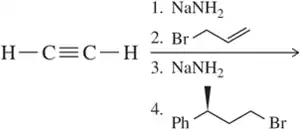
Predict the product of the following acetylide alkylations. (c)
Verified step by step guidance
1
Step 1: Understand the reaction mechanism. Acetylide alkylation involves the reaction of a terminal alkyne with a strong base to form an acetylide ion, followed by the reaction of the acetylide ion with an alkyl halide to form a new carbon-carbon bond.
Step 2: Deprotonate the terminal alkyne. Use a strong base, such as sodium amide (NaNH₂), to remove the acidic proton from the terminal alkyne, forming the acetylide ion. Represent this step as: .
Step 3: Identify the alkyl halide. The acetylide ion will act as a nucleophile and attack the electrophilic carbon of the alkyl halide, displacing the halide ion (a substitution reaction). Ensure the alkyl halide is a primary or methyl halide to avoid side reactions like elimination.
Step 4: Perform the nucleophilic substitution. The acetylide ion reacts with the alkyl halide to form a new carbon-carbon bond. Represent this step as: , where R' is the alkyl group and X is the halide.
Step 5: Predict the product. Combine the acetylide ion and the alkyl group from the alkyl halide to form the final product, which is an alkyne with the new carbon-carbon bond. Ensure the structure of the product reflects the substitution reaction accurately.
Verified video answer for a similar problem:
This video solution was recommended by our tutors as helpful for the problem above
Video duration:
5m
Play a video:
0 Comments
Key Concepts
Here are the essential concepts you must grasp in order to answer the question correctly.
Acetylide Ion
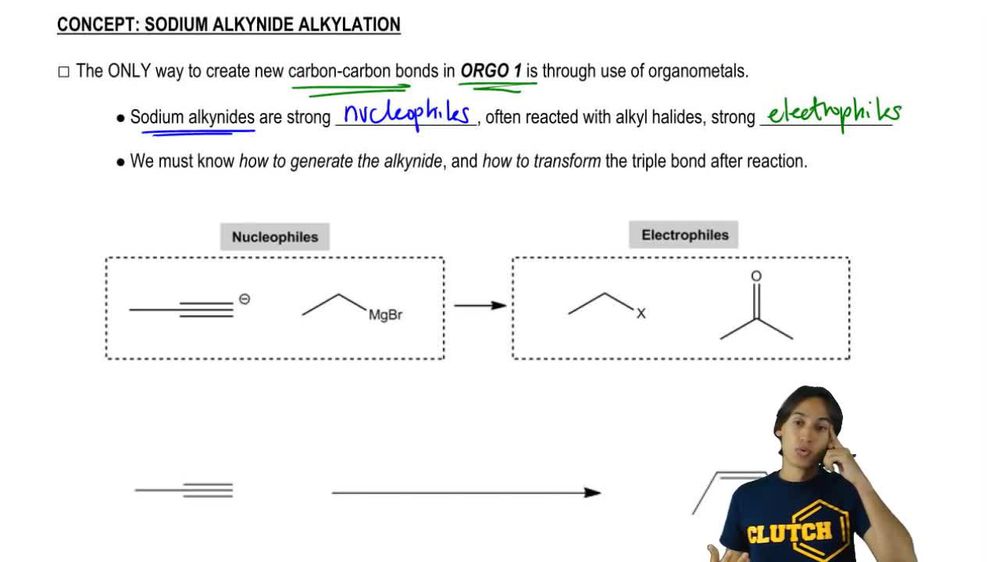
An acetylide ion is a negatively charged species formed by the deprotonation of terminal alkynes. It is a strong nucleophile, capable of attacking electrophiles in nucleophilic substitution reactions. Understanding the structure and reactivity of acetylide ions is crucial for predicting the outcomes of alkylation reactions.
Nucleophilic substitution is a fundamental reaction mechanism in organic chemistry where a nucleophile replaces a leaving group in a molecule. This process can occur via two main pathways: SN1 and SN2. The mechanism chosen depends on factors such as the structure of the substrate and the nature of the nucleophile and leaving group.
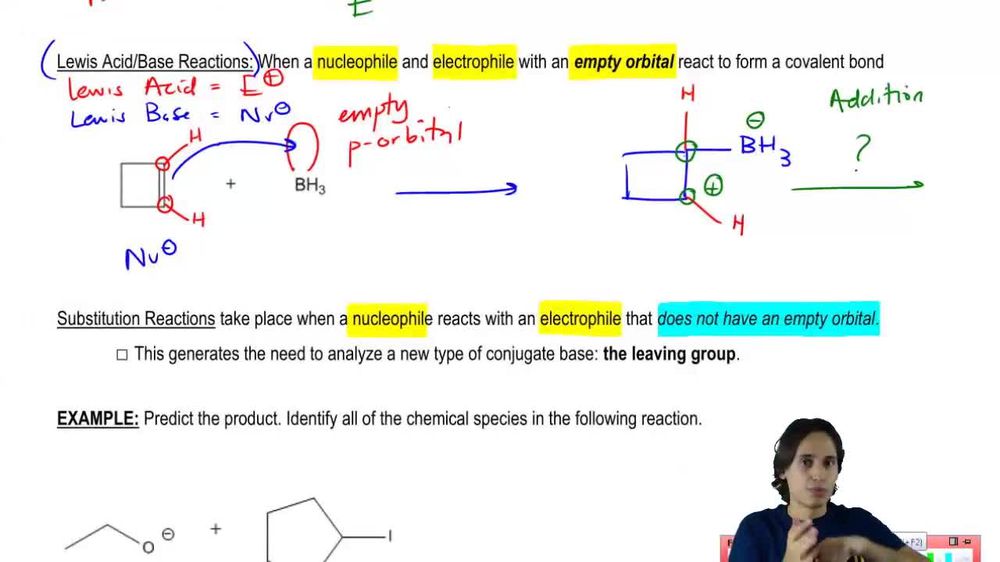
Nucleophiles and Electrophiles can react in Substitution Reactions.
Alkylation Reaction
Alkylation reactions involve the introduction of an alkyl group into a molecule, often through the reaction of a nucleophile with an alkyl halide. In the context of acetylide alkylation, the acetylide ion acts as the nucleophile, attacking the electrophilic carbon of the alkyl halide, leading to the formation of a new carbon-carbon bond.