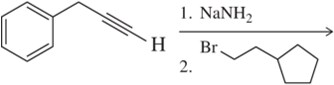
Suggest reagents you might use to generate the product from the given reactant. (a)
Verified step by step guidance
1
Step 1: Analyze the given reactant and product to identify the type of transformation required (e.g., addition, elimination, substitution, oxidation, reduction, etc.). This will help narrow down the possible reagents.
Step 2: Determine the functional groups present in the reactant and product. Compare them to see if any new functional groups are introduced or if existing ones are modified.
Step 3: Consider the stereochemistry of the product (if applicable). If the product has specific stereochemical requirements, select reagents that can achieve the desired stereochemical outcome.
Step 4: Match the transformation to common organic reactions. For example, if the product involves the addition of a hydroxyl group, you might consider hydration reactions or oxidation of an alcohol precursor.
Step 5: Select appropriate reagents based on the reaction type. For example, if the transformation involves oxidation, reagents like PCC (Pyridinium Chlorochromate) or KMnO₄ might be suitable. If reduction is required, reagents like NaBH₄ or LiAlH₄ could be used.
Verified video answer for a similar problem:
This video solution was recommended by our tutors as helpful for the problem above
Video duration:
3m
Play a video:
0 Comments
Key Concepts
Here are the essential concepts you must grasp in order to answer the question correctly.
Reagents in Organic Chemistry
Reagents are substances that are added to a chemical reaction to cause a transformation. In organic chemistry, they can include acids, bases, oxidizing agents, reducing agents, and catalysts. Understanding the role of specific reagents is crucial for predicting the outcome of reactions and generating desired products from reactants.
A reaction mechanism describes the step-by-step process by which reactants are converted into products. It includes the breaking and forming of bonds, the movement of electrons, and the intermediates formed during the reaction. Familiarity with mechanisms helps in selecting appropriate reagents and understanding how they influence the reaction pathway.
Functional groups are specific groups of atoms within molecules that are responsible for the characteristic chemical reactions of those molecules. Identifying the functional groups in both the reactant and the desired product is essential for determining which reagents will facilitate the necessary transformations to achieve the target compound.