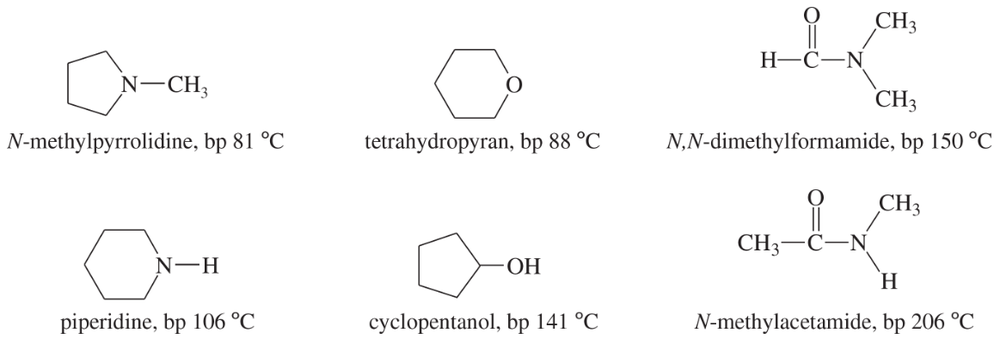
N-Methylpyrrolidine has a boiling point of 81 °C, and piperidine has a boiling point of 106 °C. c. N,N-Dimethylformamide has a boiling point of 150 °C, and N-methylacetamide has a boiling point of 206 °C, for a difference of 56 °C. Explain why these two nitrogen-containing isomers have a much larger boiling point difference than the two amine isomers. Also explain why these two amides have higher boiling points than any of the other four compounds shown (two amines, an ether, and an alcohol).
Verified step by step guidance
1
Identify the functional groups present in each compound. N-Methylpyrrolidine and piperidine are amines, while N,N-Dimethylformamide and N-methylacetamide are amides.
Understand the intermolecular forces at play. Amines primarily engage in hydrogen bonding and dipole-dipole interactions, while amides can form stronger hydrogen bonds due to the presence of both a carbonyl group and an amine group.
Compare the boiling points of the amines and amides. The larger boiling point difference between the amides (56 °C) compared to the amines (25 °C) can be attributed to the stronger hydrogen bonding in amides, which involves both the carbonyl oxygen and the nitrogen hydrogen.
Explain why amides have higher boiling points than the other compounds. Amides have stronger hydrogen bonding capabilities than ethers and alcohols due to the presence of both a carbonyl group and an amine group, which allows for more extensive hydrogen bonding networks.
Conclude that the presence of the carbonyl group in amides significantly enhances their ability to engage in hydrogen bonding, leading to higher boiling points compared to amines, ethers, and alcohols.
Verified video answer for a similar problem:
This video solution was recommended by our tutors as helpful for the problem above
Video duration:
8m
Play a video:
0 Comments
Key Concepts
Here are the essential concepts you must grasp in order to answer the question correctly.
Hydrogen Bonding
Hydrogen bonding is a strong type of dipole-dipole interaction that occurs when hydrogen is bonded to highly electronegative atoms like nitrogen or oxygen. This interaction significantly increases boiling points due to the additional energy required to break these bonds. Amides, such as N-methylacetamide, can form hydrogen bonds due to the presence of both nitrogen and oxygen, leading to higher boiling points compared to amines, which primarily rely on nitrogen.
Polarity refers to the distribution of electrical charge over the atoms in a molecule. Molecules with polar bonds, like amides, have higher boiling points because the polar nature leads to stronger intermolecular forces. The molecular structure of N,N-dimethylformamide and N-methylacetamide includes a carbonyl group, which increases polarity and intermolecular attractions, resulting in higher boiling points compared to less polar amines.
Intermolecular forces, including hydrogen bonding, dipole-dipole interactions, and van der Waals forces, determine the boiling points of compounds. Amides exhibit stronger intermolecular forces due to their ability to form hydrogen bonds and their polar nature, leading to higher boiling points. In contrast, amines primarily rely on weaker dipole-dipole interactions, resulting in lower boiling points compared to amides.