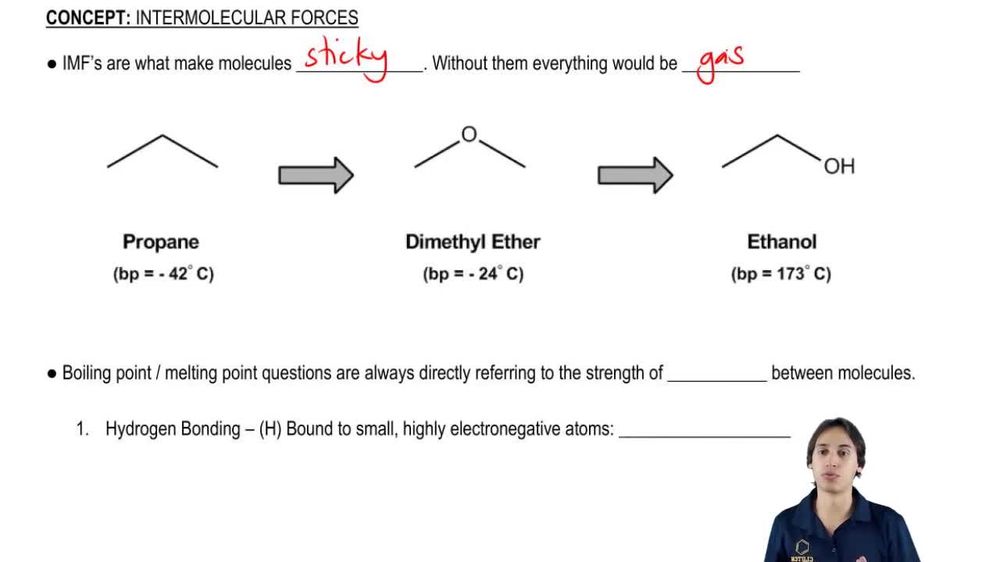
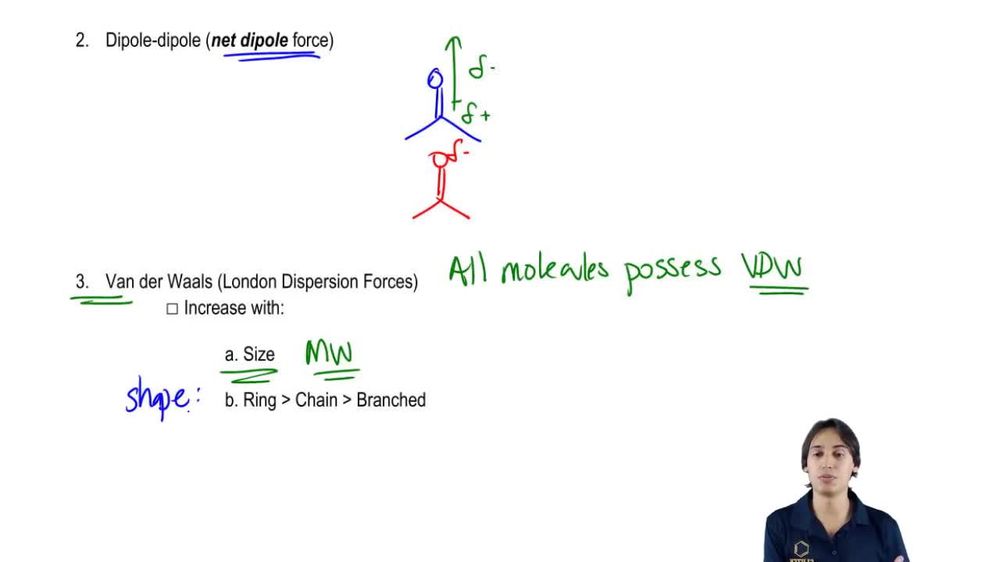
Explain why a. H2O (100 °C) has a higher boiling point than CH3OH 165 °C2. b. H2O (100 °C) has a higher boiling point than NH3 (-33 °C).
Verified step by step guidance
1
Step 1: Begin by understanding the concept of boiling point. The boiling point of a substance is the temperature at which its vapor pressure equals the external pressure, allowing the substance to transition from liquid to gas. Boiling points are influenced by intermolecular forces such as hydrogen bonding, dipole-dipole interactions, and London dispersion forces.
Step 2: Compare the boiling points of H2O and CH3OH. Both molecules can form hydrogen bonds due to the presence of highly electronegative atoms (oxygen) bonded to hydrogen. However, H2O can form stronger and more extensive hydrogen bonding networks because each water molecule has two hydrogen atoms and two lone pairs on oxygen, allowing it to act as both a hydrogen bond donor and acceptor. CH3OH, on the other hand, has only one hydrogen atom available for hydrogen bonding and fewer lone pairs. This results in weaker intermolecular forces in CH3OH compared to H2O, leading to a lower boiling point for CH3OH.
Step 3: Compare the boiling points of H2O and NH3. Both molecules can form hydrogen bonds, but the extent and strength of hydrogen bonding differ. H2O has a highly electronegative oxygen atom with two lone pairs, enabling it to form stronger hydrogen bonds. NH3 has a less electronegative nitrogen atom and only one lone pair, which limits the strength and number of hydrogen bonds it can form. Additionally, the molecular geometry of NH3 (trigonal pyramidal) further reduces the efficiency of hydrogen bonding compared to the bent geometry of H2O. These factors contribute to H2O having a higher boiling point than NH3.
Step 4: Highlight the role of molecular polarity and electronegativity. H2O is a highly polar molecule due to the significant electronegativity difference between oxygen and hydrogen, as well as its bent geometry. This polarity enhances the strength of hydrogen bonding. CH3OH and NH3 are less polar in comparison, which reduces the strength of their intermolecular forces and contributes to their lower boiling points.
Step 5: Summarize the key factors influencing boiling points. The boiling point of H2O is higher than CH3OH and NH3 due to its ability to form stronger and more extensive hydrogen bonding networks, its higher molecular polarity, and the electronegativity of oxygen compared to nitrogen. These factors collectively result in stronger intermolecular forces in H2O, requiring more energy to overcome during the phase transition from liquid to gas.
Verified video answer for a similar problem:
This video solution was recommended by our tutors as helpful for the problem above
Video duration:
6m
Play a video:
0 Comments
Key Concepts
Here are the essential concepts you must grasp in order to answer the question correctly.
Hydrogen Bonding
Hydrogen bonding is a strong type of dipole-dipole interaction that occurs when hydrogen is bonded to highly electronegative atoms like oxygen or nitrogen. In water (H2O), each molecule can form up to four hydrogen bonds, leading to a higher boiling point due to the significant energy required to break these interactions. In contrast, while CH3OH also forms hydrogen bonds, its structure and fewer hydrogen bonds result in a lower boiling point.
Molecular weight can influence boiling points, but it is not the sole factor. Generally, larger molecules with greater molecular weights have higher boiling points due to increased van der Waals forces. However, in the case of H2O and NH3, the strong hydrogen bonding in water outweighs the effects of molecular weight, resulting in a higher boiling point despite NH3 having a lower molecular weight.
How IMFs are related to melting and boiling points.
Intermolecular Forces
Intermolecular forces are the forces of attraction between molecules, which significantly affect physical properties like boiling points. Water exhibits strong hydrogen bonding, while ammonia (NH3) has weaker hydrogen bonds due to its lower electronegativity compared to oxygen. This difference in intermolecular forces explains why H2O has a much higher boiling point than NH3, despite NH3 being a polar molecule.