The sulfur and oxygen in methanethiol and methanol are both sp3 hybridized. Why is the S―H bond longer than the O―H bond?
Verified step by step guidance
1
Understand the concept of bond length: Bond length is the distance between the nuclei of two bonded atoms. It depends on the size of the atoms and the type of bond (single, double, etc.). Larger atoms tend to form longer bonds because their electron clouds are more spread out.
Compare the atomic sizes of sulfur (S) and oxygen (O): Sulfur is in Period 3 of the periodic table, while oxygen is in Period 2. Atoms in Period 3 are larger than those in Period 2 because they have an additional electron shell. This means sulfur has a larger atomic radius than oxygen.
Relate atomic size to bond length: Since sulfur is larger than oxygen, the S―H bond will naturally be longer than the O―H bond. The larger size of sulfur increases the distance between the sulfur nucleus and the hydrogen nucleus compared to the oxygen-hydrogen bond.
Consider hybridization and bond type: Both sulfur and oxygen in methanethiol and methanol are sp³ hybridized, meaning they form single bonds with hydrogen. The hybridization does not significantly affect the bond length in this case, as the difference is primarily due to the atomic size of sulfur and oxygen.
Conclude the reasoning: The S―H bond is longer than the O―H bond because sulfur is a larger atom than oxygen, leading to a greater bond length due to the increased distance between the bonded nuclei.
Verified video answer for a similar problem:
This video solution was recommended by our tutors as helpful for the problem above
Video duration:
4m
Play a video:
0 Comments
Key Concepts
Here are the essential concepts you must grasp in order to answer the question correctly.
Hybridization
Hybridization is the concept in organic chemistry that describes the mixing of atomic orbitals to form new hybrid orbitals. In the case of methanethiol and methanol, both sulfur and oxygen are sp³ hybridized, meaning they form four equivalent orbitals for bonding. This hybridization influences the geometry and bond characteristics of the molecules.
Bond length refers to the distance between the nuclei of two bonded atoms. It is influenced by factors such as atomic size, bond order, and the presence of lone pairs. In general, larger atoms form longer bonds; thus, the S―H bond in methanethiol is longer than the O―H bond in methanol due to sulfur's larger atomic radius compared to oxygen.
Electronegativity is a measure of an atom's ability to attract and hold onto electrons in a bond. Oxygen is more electronegative than sulfur, which affects the bond character. The stronger attraction in the O―H bond leads to a shorter bond length compared to the S―H bond, where the weaker attraction results in a longer bond.

 4:37 minutes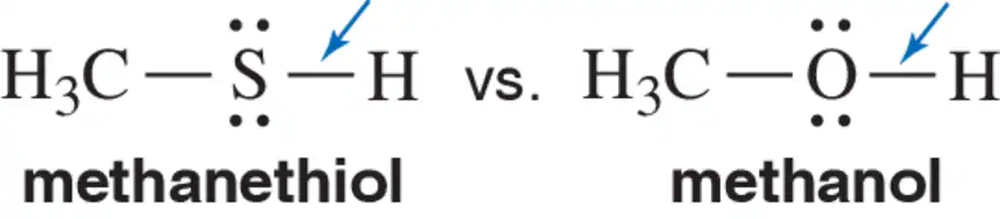
 Verified step by step guidance

 10:43
10:43