Show how you would accomplish the following syntheses in good yields. (b)
Verified step by step guidance
1
Step 1: Analyze the starting material and the target molecule. The starting material is benzoic acid (C₆H₅COOH), and the target molecule is phenyl acetate (C₆H₅COOCOCH₃). This transformation involves converting the carboxylic acid group into an ester group.
Step 2: Recognize the reaction type. This is an esterification reaction, specifically a reaction between a carboxylic acid and an acid anhydride to form an ester.
Step 3: Select the appropriate reagent. To achieve this transformation, use acetic anhydride ((CH₃CO)₂O) as the reagent. Acetic anhydride reacts with benzoic acid to form phenyl acetate and acetic acid as a byproduct.
Step 4: Outline the reaction conditions. The reaction typically requires mild heating to facilitate the esterification process. No catalyst is necessary because acetic anhydride is reactive enough to proceed without additional activation.
Step 5: Write the reaction mechanism. The carboxylic acid group of benzoic acid attacks the carbonyl carbon of acetic anhydride, leading to the formation of phenyl acetate and acetic acid. Ensure the reaction is carried out under anhydrous conditions to prevent hydrolysis of the anhydride.
Verified video answer for a similar problem:
This video solution was recommended by our tutors as helpful for the problem above
Video duration:
3m
Play a video:
0 Comments
Key Concepts
Here are the essential concepts you must grasp in order to answer the question correctly.
Carboxylic Acids
Carboxylic acids are organic compounds characterized by the presence of a carboxyl group (-COOH). They are known for their acidic properties and can undergo various reactions, including esterification and conversion to derivatives. Understanding their structure and reactivity is crucial for synthesizing derivatives, as shown in the provided reaction.
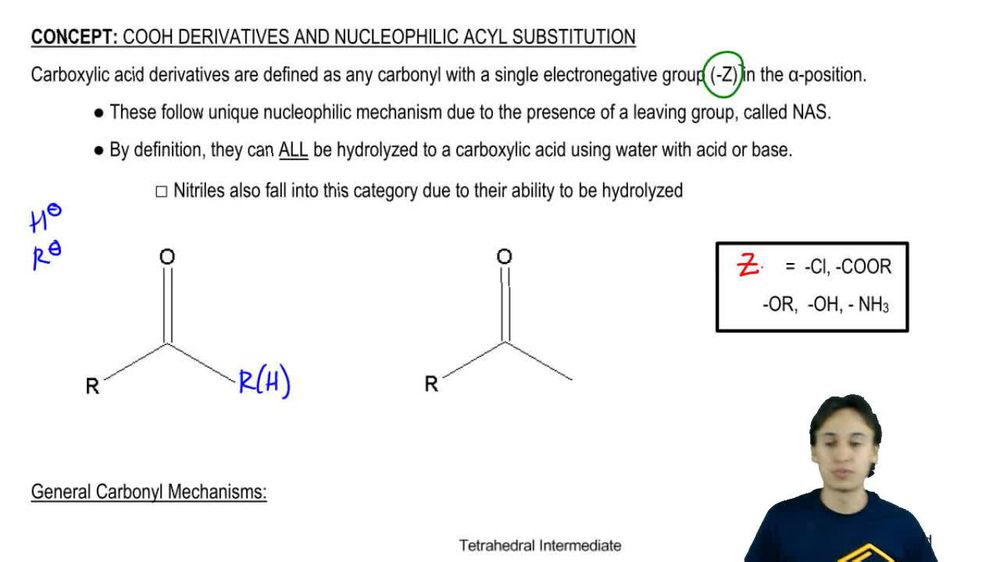
Carboxylic acid derivatives include compounds such as esters, amides, and anhydrides, which retain the carboxyl group but have different substituents. These derivatives can be synthesized from carboxylic acids through various chemical reactions, often involving nucleophilic acyl substitution. Recognizing the types of derivatives and their formation mechanisms is essential for successful synthesis.
Nucleophilic acyl substitution is a fundamental reaction in organic chemistry where a nucleophile attacks the carbonyl carbon of a carboxylic acid or its derivative, leading to the replacement of a leaving group. This mechanism is key in converting carboxylic acids into their derivatives, as it allows for the introduction of new functional groups while maintaining the carbon skeleton. Mastery of this concept is vital for achieving good yields in synthesis.

 3:24 minutes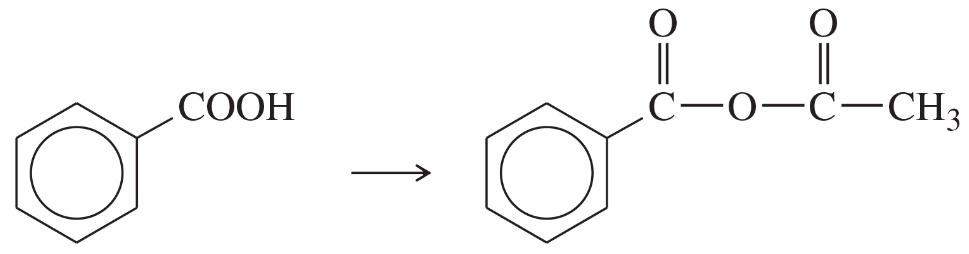
 Verified step by step guidance
 04:20
04:20