Show how you would accomplish the following syntheses in good yields. (a)
Verified step by step guidance
1
Step 1: Identify the starting material and the target product. The starting material is aniline (C₆H₅NH₂), and the target product is benzamide (C₆H₅CONH₂). This transformation involves converting the amino group (-NH₂) into an amide group (-CONH₂).
Step 2: Recognize the reagent required for this transformation. To convert an amine into an amide, an acylating agent such as acetic anhydride (CH₃CO)₂O or an acyl chloride (e.g., CH₃COCl) can be used. In this case, formyl chloride (HCOCl) is appropriate to introduce the formyl group (-CHO).
Step 3: Write the reaction mechanism. The nucleophilic amino group (-NH₂) of aniline attacks the electrophilic carbon of the formyl chloride (HCOCl), leading to the formation of an intermediate. This intermediate undergoes deprotonation to yield benzamide.
Step 4: Consider reaction conditions. The reaction typically requires a base such as pyridine or triethylamine to neutralize the HCl byproduct and facilitate the reaction. The reaction is carried out under mild conditions to avoid overreaction or degradation of the product.
Step 5: Purify the product. After the reaction is complete, the crude product can be purified using techniques such as recrystallization or column chromatography to obtain benzamide in good yield.
Verified video answer for a similar problem:
This video solution was recommended by our tutors as helpful for the problem above
Video duration:
2m
Play a video:
0 Comments
Key Concepts
Here are the essential concepts you must grasp in order to answer the question correctly.
Amine Reactivity
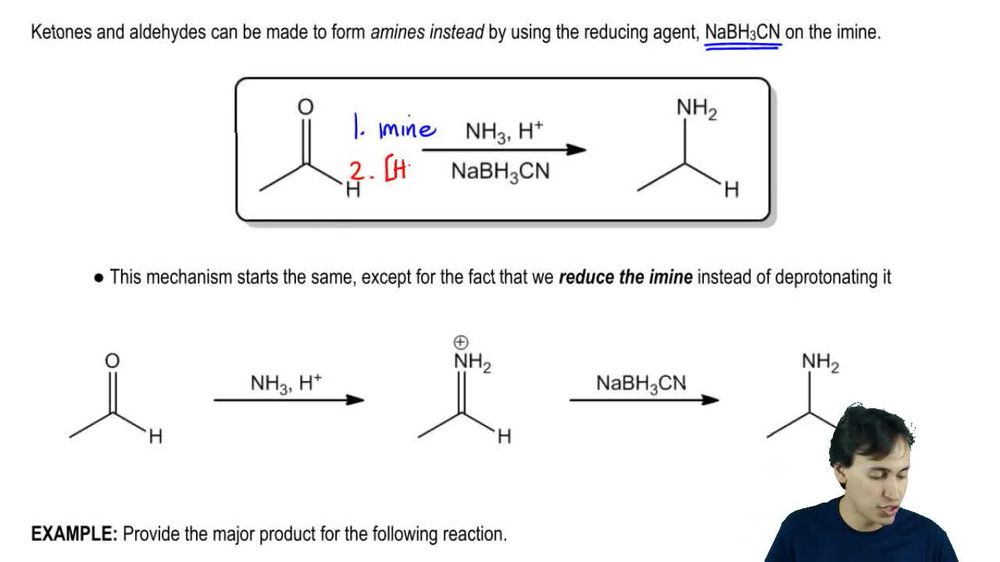
Amines are organic compounds derived from ammonia, characterized by the presence of one or more alkyl or aryl groups attached to a nitrogen atom. They can act as nucleophiles in chemical reactions, meaning they can donate a pair of electrons to form bonds with electrophiles. Understanding the reactivity of amines is crucial for predicting their behavior in synthesis, particularly in forming derivatives like amides.
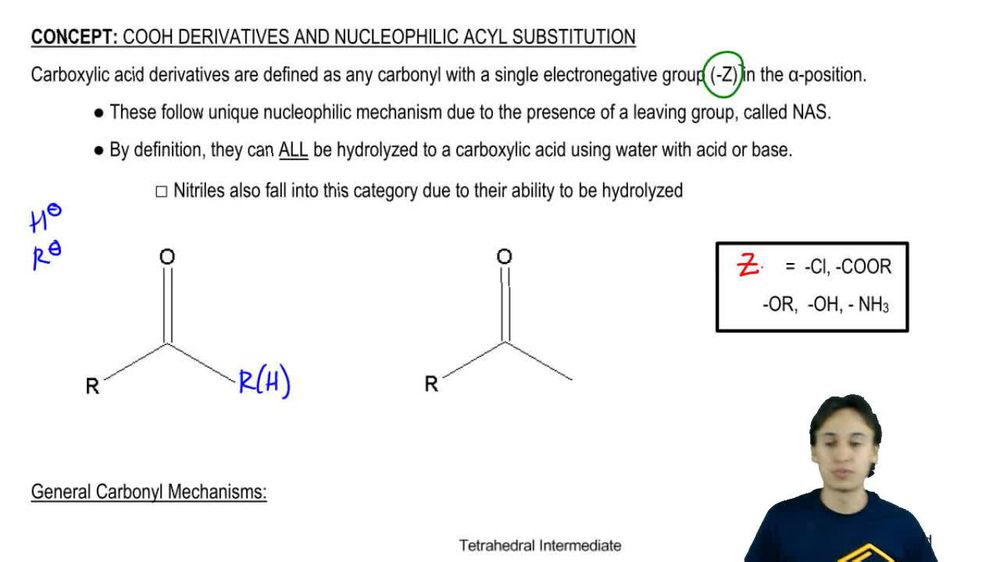
Carboxylic acid derivatives include compounds such as esters, amides, and anhydrides, which are derived from carboxylic acids. They retain the carboxyl functional group but have different substituents that influence their reactivity and properties. In the context of the synthesis shown, converting an amine to an amide (a type of carboxylic acid derivative) is a common transformation in organic chemistry.
Synthesis strategies in organic chemistry involve planning and executing a series of chemical reactions to construct a desired compound. This includes selecting appropriate reagents, conditions, and reaction pathways to achieve high yields. In the given synthesis, understanding how to effectively convert an amine to an amide through specific reagents and conditions is essential for successful execution.

 2:41 minutes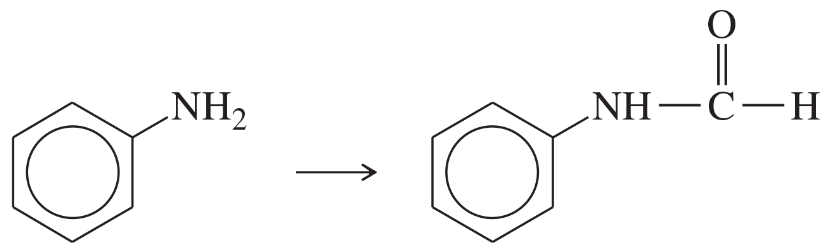
 Verified step by step guidance
 07:12
07:12