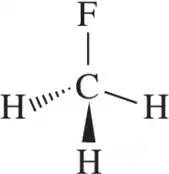
Use hybrid orbitals to draw the following molecules. (a)
Verified step by step guidance
1
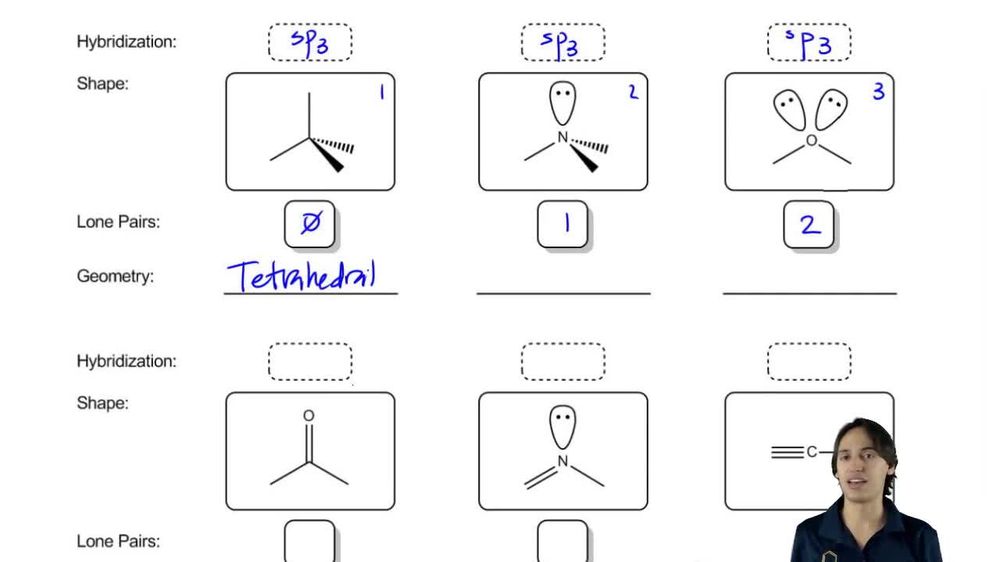
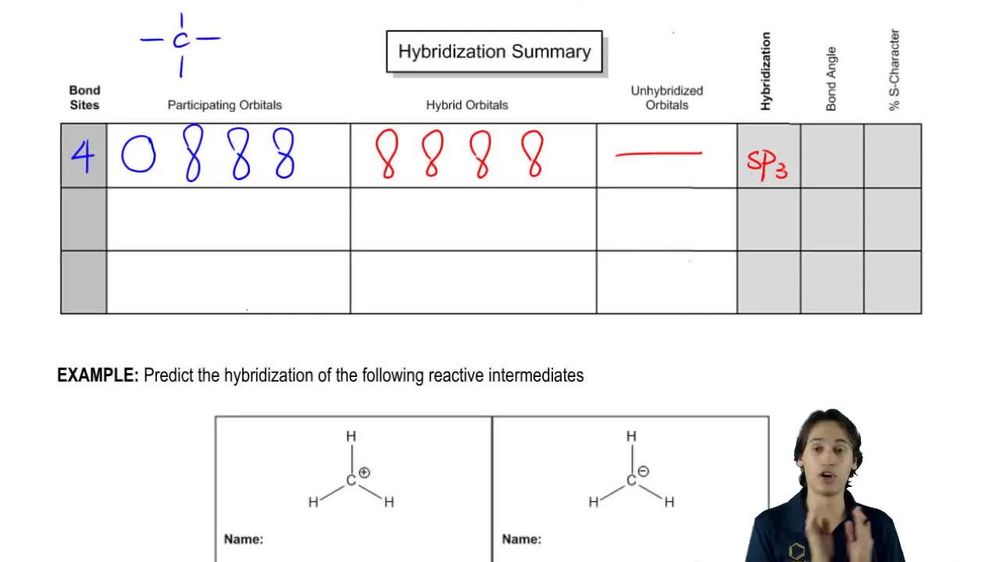
Step 1: Understand the concept of hybrid orbitals. Hybrid orbitals are formed by the mixing of atomic orbitals (such as s, p, and sometimes d orbitals) to create new orbitals that are better suited for bonding in molecules. Common types include sp, sp², and sp³ hybridization.
Step 2: Determine the central atom in the molecule and its steric number. The steric number is calculated as the sum of the number of bonded atoms and lone pairs around the central atom. This will help identify the type of hybridization.
Step 3: Assign the hybridization based on the steric number. For example: steric number 2 corresponds to sp hybridization, steric number 3 corresponds to sp² hybridization, and steric number 4 corresponds to sp³ hybridization.
Step 4: Draw the molecule using the hybrid orbitals. Represent the central atom with its hybrid orbitals and show the bonding with other atoms. For example, sp hybrid orbitals form linear geometry, sp² hybrid orbitals form trigonal planar geometry, and sp³ hybrid orbitals form tetrahedral geometry.
Step 5: Include any lone pairs on the central atom in the drawing, ensuring that the geometry matches the hybridization. Verify that the drawing adheres to the molecular geometry and bonding rules.
Verified video answer for a similar problem:
This video solution was recommended by our tutors as helpful for the problem above
Video duration:
1m
Play a video:
0 Comments
Key Concepts
Here are the essential concepts you must grasp in order to answer the question correctly.
Hybridization
Hybridization is the process of combining atomic orbitals to form new hybrid orbitals that can accommodate the bonding requirements of a molecule. This concept is crucial for understanding molecular geometry and bonding properties, as it explains how atoms can form equivalent bonds in molecules. For example, in methane (CH4), the carbon atom undergoes sp3 hybridization, resulting in four equivalent sp3 hybrid orbitals that form sigma bonds with hydrogen atoms.
Molecular geometry refers to the three-dimensional arrangement of atoms within a molecule, which is determined by the hybridization of the central atom and the presence of lone pairs. Understanding molecular geometry is essential for predicting the shape and reactivity of molecules. For instance, the tetrahedral shape of methane arises from the sp3 hybridization of carbon, leading to bond angles of approximately 109.5 degrees.
In molecular structures, bonding pairs of electrons are shared between atoms to form covalent bonds, while lone pairs are non-bonding pairs of electrons localized on an atom. The presence of lone pairs affects the geometry and angles between bonds due to their repulsive interactions. For example, in ammonia (NH3), the lone pair on nitrogen compresses the H-N-H bond angle to about 107 degrees, deviating from the ideal tetrahedral angle.