What orbitals contain the electrons represented as lone pairs in the structures of purine, and pyrimidine?
Verified step by step guidance
1
Understand the structures of purine and pyrimidine: Purine is a bicyclic aromatic compound with a six-membered pyrimidine ring fused to a five-membered imidazole ring. Pyrimidine is a six-membered aromatic ring containing two nitrogen atoms at positions 1 and 3.
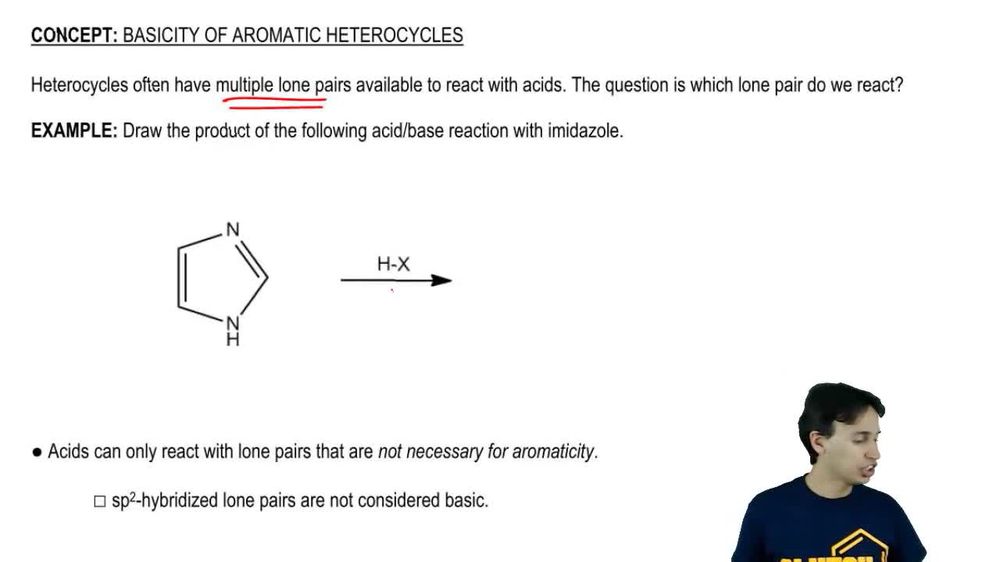
Identify the lone pairs on the nitrogen atoms in purine and pyrimidine: Lone pairs are non-bonding electron pairs located on the nitrogen atoms in these structures. Each nitrogen atom in the aromatic rings contributes one lone pair.
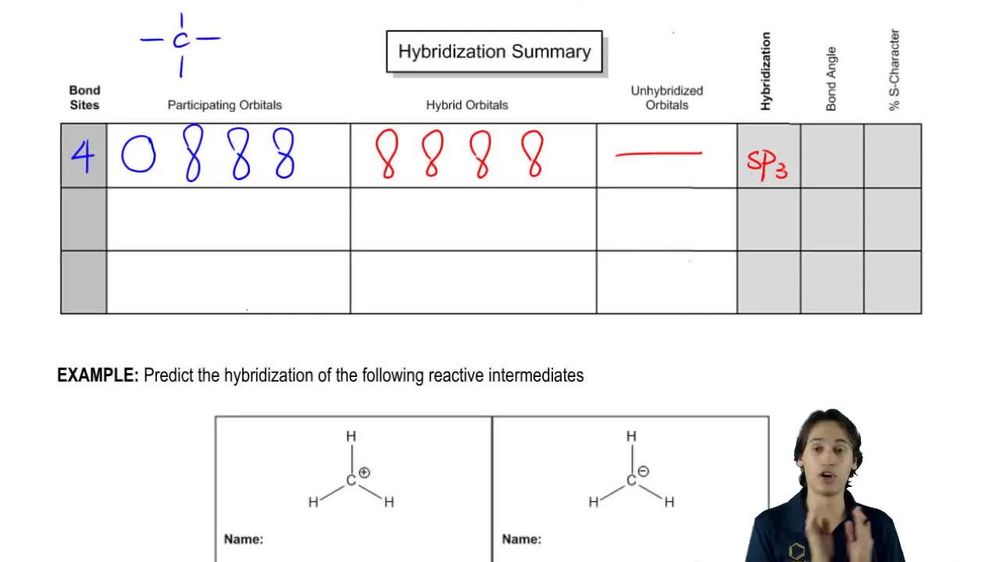
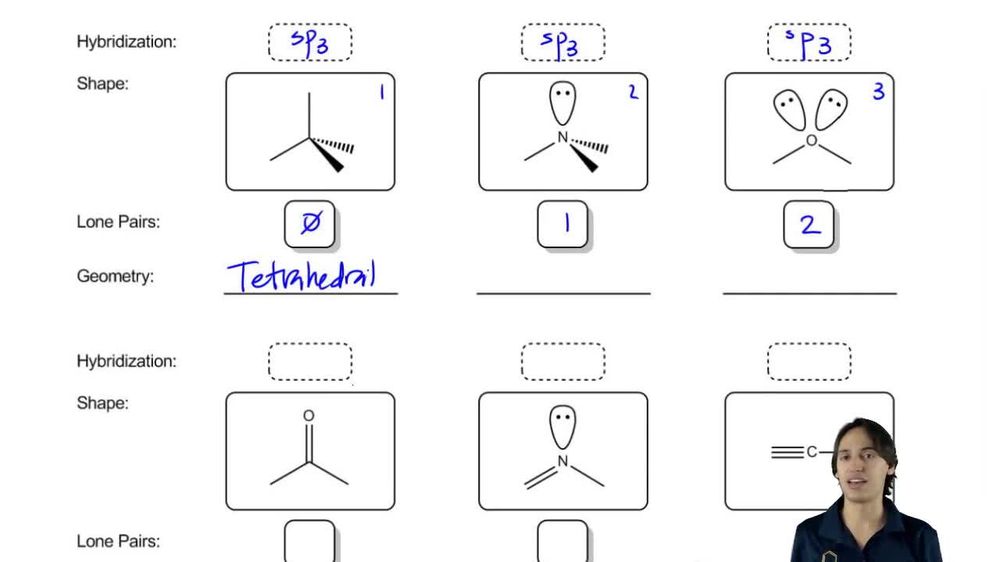
Determine the hybridization of the nitrogen atoms: In aromatic systems like purine and pyrimidine, the nitrogen atoms are sp² hybridized. This hybridization allows the nitrogen atoms to participate in the conjugated π-system of the aromatic ring.
Assign the orbitals for the lone pairs: In sp² hybridized nitrogen atoms, one of the sp² orbitals contains the lone pair of electrons. The other two sp² orbitals are used for sigma bonding, and the unhybridized p orbital is part of the π-system.
Conclude the orbital location of the lone pairs: The lone pairs on the nitrogen atoms in purine and pyrimidine are located in sp² hybrid orbitals, which are oriented in the plane of the aromatic ring and do not participate in the π-system.
Verified video answer for a similar problem:
This video solution was recommended by our tutors as helpful for the problem above
Video duration:
3m
Play a video:
0 Comments
Key Concepts
Here are the essential concepts you must grasp in order to answer the question correctly.
Lone Pairs
Lone pairs are pairs of valence electrons that are not involved in bonding and are localized on a single atom. In organic molecules, they play a crucial role in determining the molecule's geometry and reactivity. Understanding where these lone pairs are located helps in predicting molecular interactions and the overall shape of the molecule.
Hybridization is the concept of mixing atomic orbitals to form new hybrid orbitals that can accommodate bonding and lone pairs. In purines and pyrimidines, the hybridization of carbon and nitrogen atoms influences the arrangement of electrons and the geometry of the molecule. Recognizing the hybridization state is essential for understanding the spatial distribution of lone pairs.
Molecular geometry refers to the three-dimensional arrangement of atoms in a molecule, which is influenced by the presence of lone pairs and bonding pairs of electrons. The VSEPR (Valence Shell Electron Pair Repulsion) theory helps predict the shape of molecules based on electron pair repulsion. This understanding is vital for analyzing the structures of purine and pyrimidine, as it affects their biological function.

 3:21 minutes
 Verified step by step guidance
 02:04
02:04