Show how you would accomplish the following multistep syntheses, using the indicated starting material and any necessary reagents. (a) hept-6-en-1-ol → ε-caprolactone (b) methoxybenzene → p-methoxybenzamide
Verified step by step guidance
1
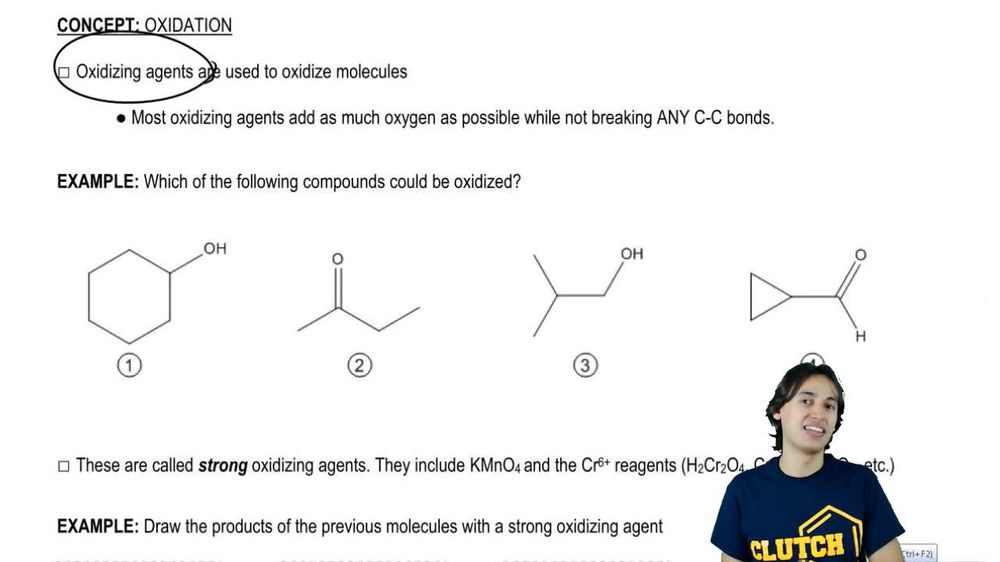
For part (a): Convert hept-6-en-1-ol to ε-caprolactone. Step 1: Oxidize the primary alcohol group (-CH2OH) in hept-6-en-1-ol to a carboxylic acid (-COOH) using an oxidizing agent such as Jones reagent (CrO3/H2SO4) or PCC in water.
Step 2: Perform an intramolecular cyclization reaction to form the lactone ring. Use an acid catalyst (e.g., H2SO4 or p-TsOH) to promote the nucleophilic attack of the hydroxyl group on the carboxylic acid, forming ε-caprolactone.
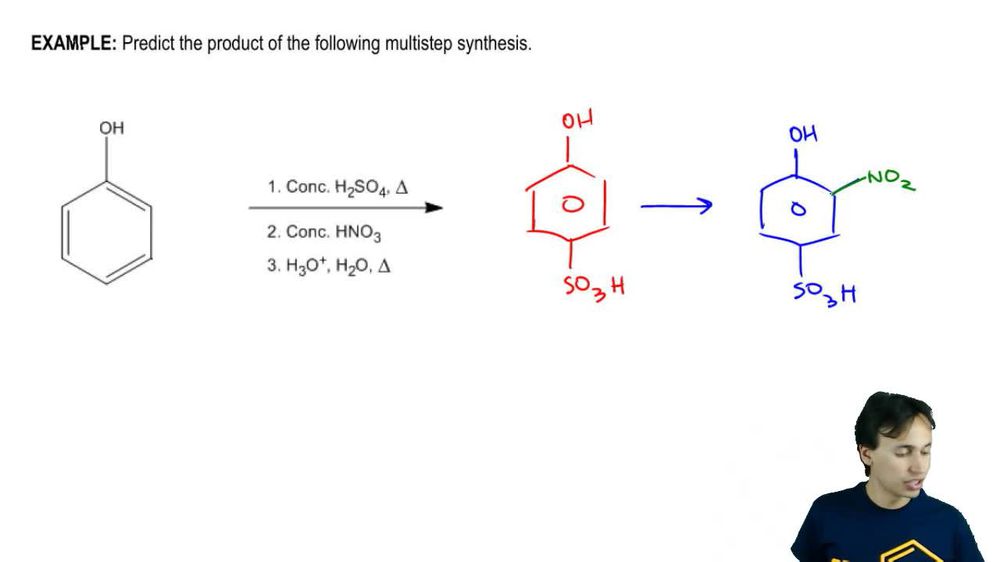
For part (b): Convert methoxybenzene to p-methoxybenzamide. Step 1: Perform a nitration reaction on methoxybenzene using a mixture of concentrated HNO3 and H2SO4 to introduce a nitro group (-NO2) at the para position relative to the methoxy group (-OCH3).
Step 2: Reduce the nitro group (-NO2) to an amine group (-NH2) using a reducing agent such as Sn/HCl or Fe/HCl.
Step 3: Convert the amine group (-NH2) to an amide group (-CONH2) by reacting the para-methoxyaniline with an acylating agent such as acetic anhydride or by using ammonium carbonate and a carboxylic acid derivative.
Verified video answer for a similar problem:
This video solution was recommended by our tutors as helpful for the problem above
Video duration:
4m
Play a video:
0 Comments
Key Concepts
Here are the essential concepts you must grasp in order to answer the question correctly.
Multistep Synthesis
Multistep synthesis involves a series of chemical reactions that transform a starting material into a desired product through intermediate compounds. Understanding the sequence of reactions, including the reagents and conditions required at each step, is crucial for successfully completing the synthesis. This concept emphasizes the importance of planning and predicting the outcomes of each reaction to achieve the final product efficiently.
Functional group transformation refers to the process of converting one functional group into another during a chemical reaction. This is essential in organic synthesis as it allows chemists to modify the reactivity and properties of molecules. Recognizing how different functional groups can be interconverted, such as alcohols to esters or amines, is key to designing effective synthetic pathways.
The choice of reagents and reaction conditions is critical in organic synthesis, as they dictate the course and efficiency of the reactions. Different reagents can facilitate specific transformations, while conditions such as temperature, pressure, and solvent can influence reaction rates and selectivity. A thorough understanding of these factors is necessary to optimize the synthesis and ensure the desired product is obtained.

 4:56 minutes
 Verified step by step guidance
 02:15
02:15