Show how you would accomplish the following multistep syntheses. You may use any additional reagents and solvents you need. (a) PhCH2CH2OH → PhCH2CH2COOH
Verified step by step guidance
1
Step 1: Begin by oxidizing the primary alcohol group (-CH2OH) in PhCH2CH2OH to an aldehyde (-CHO). This can be achieved using a mild oxidizing agent such as PCC (Pyridinium Chlorochromate) in an anhydrous solvent like dichloromethane (CH2Cl2). The intermediate product will be PhCH2CH2CHO.
Step 2: Next, oxidize the aldehyde (-CHO) group in PhCH2CH2CHO to a carboxylic acid (-COOH). This can be accomplished using a stronger oxidizing agent such as KMnO4 (Potassium Permanganate) or Jones reagent (CrO3/H2SO4). The product will be PhCH2CH2COOH.
Step 3: Ensure proper reaction conditions for each step. For the PCC oxidation, maintain an anhydrous environment to prevent overoxidation. For the aldehyde oxidation, use aqueous KMnO4 under acidic or neutral conditions to achieve the desired carboxylic acid.
Step 4: Purify the final product (PhCH2CH2COOH) using techniques such as recrystallization or extraction, depending on the solubility and physical properties of the compound.
Step 5: Confirm the structure of the final product using spectroscopic methods such as IR (to verify the presence of the carboxylic acid group), NMR (to confirm the structure of the molecule), and possibly mass spectrometry for molecular weight determination.
Verified video answer for a similar problem:
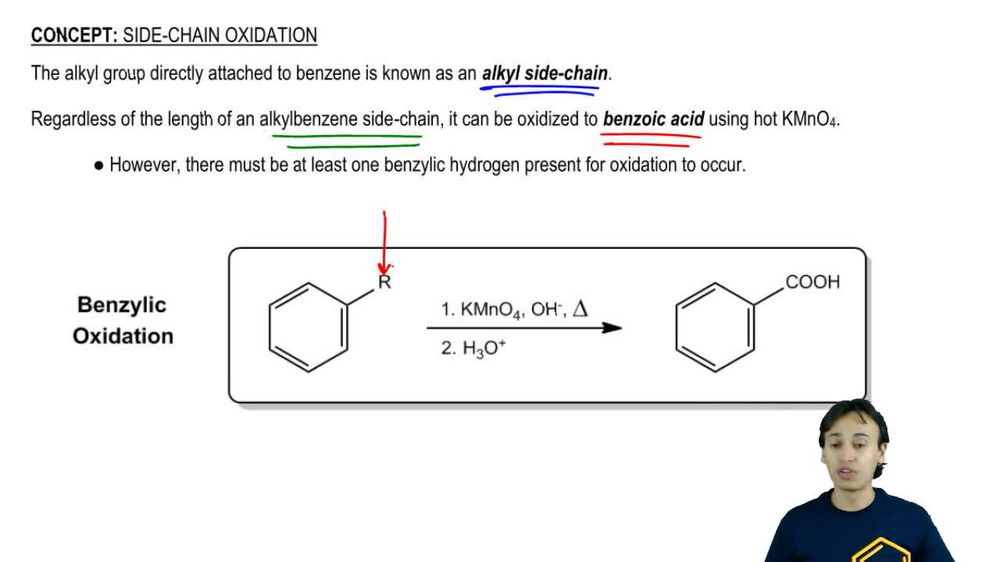
This video solution was recommended by our tutors as helpful for the problem above
Video duration:
2m
Play a video:
0 Comments
Key Concepts
Here are the essential concepts you must grasp in order to answer the question correctly.
Oxidation Reactions
Oxidation reactions involve the loss of electrons or an increase in oxidation state, often resulting in the conversion of alcohols to carboxylic acids. In this synthesis, the primary alcohol (PhCH2CH2OH) can be oxidized to a carboxylic acid (PhCH2CH2COOH) using oxidizing agents such as potassium permanganate (KMnO4) or chromium trioxide (CrO3). Understanding the conditions and reagents for effective oxidation is crucial for this transformation.
The choice of reagents and solvents is critical in organic synthesis as they influence the reaction pathway, yield, and selectivity. For the oxidation of the alcohol to a carboxylic acid, selecting an appropriate oxidizing agent and solvent (like water or an alcohol) can enhance the reaction efficiency. Familiarity with common reagents and their properties is essential for successful synthesis.
Functional group interconversion refers to the transformation of one functional group into another, which is a fundamental concept in organic chemistry. In this case, converting a primary alcohol to a carboxylic acid exemplifies this concept. Understanding the mechanisms and conditions that facilitate these conversions is vital for planning multistep syntheses effectively.